

SDCCD Cyberattack Exposed a Larger Problem: Operational Readiness Failure
IT Trends Weekly – Issue 037 – 5/10/26
The SDCCD cyberattack immediately became a cybersecurity story, but the larger lesson was never purely technical. It was operational. The disruption exposed how deeply modern institutions now depend on digital systems simply to function day to day — and how fragile those operations can become once core services are interrupted.
Students reportedly experienced login issues, communications disruptions, system instability, and operational uncertainty as the San Diego Community College District worked through the incident response process.[1] Local media coverage focused heavily on the visible technology impact, but underneath the technical outage sat a more important governance question:
What happens when an organization can no longer operate normally?
That question now sits at the center of modern operational resilience cybersecurity planning.
The most important lesson from this incident is not whether attackers gained access, how the intrusion occurred, or what tools were affected. Those details matter operationally, but they are not the central governance issue. The larger issue is that many organizations — especially public-sector and education environments — have become operationally dependent on digital systems without fully operationalizing continuity planning around those dependencies.
This is what modern operational dependency looks like.
The SDCCD cyberattack demonstrated how quickly operational instability can emerge once core digital systems become unavailable.
Most organizations still think about cybersecurity primarily through a prevention lens. Firewalls, endpoint protection, MFA, email filtering, and detection tooling all remain essential. But prevention alone does not determine resilience anymore. Modern environments are simply too interconnected, too cloud-dependent, and too operationally centralized for prevention to be the sole measurement of maturity.
Detection is not resilience.
An organization may identify malicious activity quickly and still suffer major operational disruption if continuity procedures, communications plans, delegated authority structures, and recovery coordination are immature. That distinction matters enormously in public-sector cybersecurity environments where operational continuity directly affects students, residents, employees, and public trust.
The SDCCD disruption illustrates how quickly cyber incidents evolve into operational events. Identity systems, cloud platforms, collaboration tools, communications systems, ticketing systems, learning platforms, and administrative workflows are now deeply intertwined. When those systems become unavailable, organizations no longer lose only technology functionality — they lose operational stability.
Organizations no longer fail gracefully.
That may be the most important cybersecurity reality facing leadership teams in 2026.
Historically, operational interruptions were often isolated. One system failed while others remained functional. Modern digital environments behave differently. Identity services connect to cloud applications. Cloud applications connect to collaboration platforms. Communications systems depend on centralized authentication. Administrative functions depend on SaaS availability. Recovery coordination itself often depends on digital tools that may also become impaired during an incident.
The result is cascading operational uncertainty.
For higher education cybersecurity environments, the impact becomes especially visible because students immediately feel the disruption. Access to coursework, communication channels, enrollment systems, account access, financial systems, and institutional messaging can all become unstable simultaneously. Even when organizations respond responsibly and methodically, the visible disruption can rapidly affect public confidence.
That is not a criticism of any single institution.
It is a governance warning for everyone else.
Public-sector organizations increasingly carry enterprise-level operational risk while operating with constrained staffing, aging infrastructure, fragmented governance models, and limited recovery resources.[2] Many municipalities, educational institutions, and regional agencies now manage highly complex digital ecosystems that rival large private-sector environments in operational dependency, but often without equivalent cybersecurity maturity investments.
The future of cybersecurity is operational continuity during disruption.
That shift fundamentally changes how leadership teams should think about preparedness.
Traditional cybersecurity discussions often focus on perimeter defense, detection rates, or malware prevention statistics. Those remain important tactical metrics, but operational survivability has become the more meaningful executive measurement. Increasingly, the defining question is no longer “Can we prevent every incident?” but rather:
Can we continue functioning responsibly while disruption occurs?
That is an operational governance question, not merely a technical one.
NIST’s incident response lifecycle emphasizes preparation, detection and analysis, containment, eradication, recovery, and post-incident improvement.[3] Too many organizations still overweight the detection phase while underinvesting in operational recovery coordination and continuity execution.
That imbalance becomes dangerous during real-world disruption.
Operational resilience requires organizations to predefine communications workflows, authority delegation, escalation structures, manual fallback procedures, continuity priorities, and recovery sequencing before an incident occurs. Those decisions become exponentially more difficult once operational stress begins affecting leadership teams in real time.
Most organizations still treat cybersecurity as a technical department instead of an operational discipline.
That mindset is becoming increasingly unsustainable.
Cybersecurity now directly affects operational continuity, legal exposure, public trust, communications stability, service delivery, leadership credibility, and organizational survivability. It can no longer exist as an isolated IT function operating independently from executive governance.
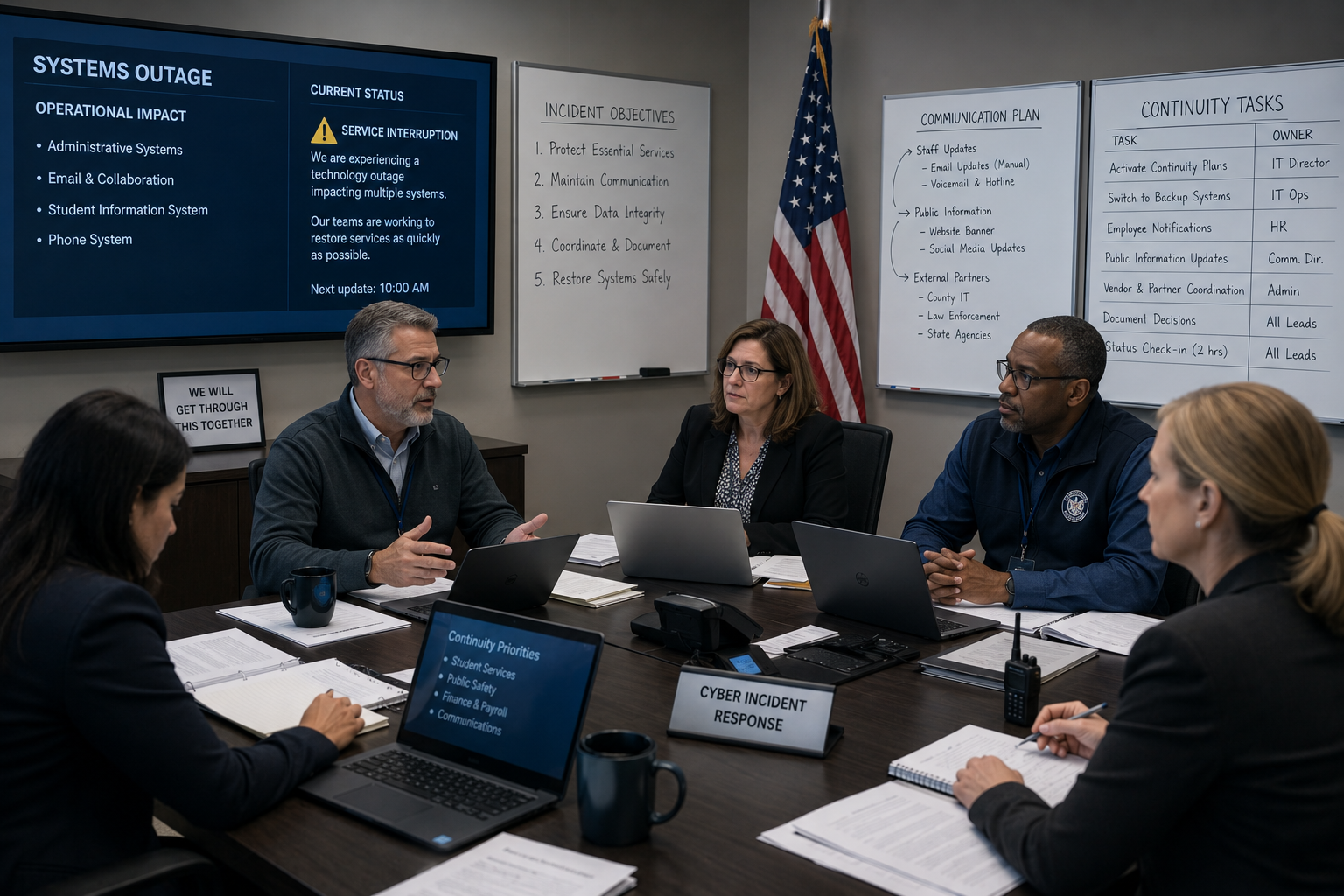
Organizations that respond effectively to cyber disruption typically share several characteristics. They conduct tabletop exercises regularly. They establish continuity priorities before incidents occur. They clarify decision authority during outages. They maintain alternative communications procedures. They understand which systems are mission-critical and which services can tolerate temporary degradation. The SDCCD cyberattack also reinforced how critical pre-established recovery coordination becomes during large-scale operational disruption.
Most importantly, mature organizations understand that outage duration matters more than initial compromise.
That concept is often misunderstood outside governance circles.
A successful intrusion is certainly serious, but operational damage frequently correlates more closely with recovery duration than with the initial event itself. Long-duration outages create uncertainty, confusion, communications instability, reputational degradation, and operational fatigue. They also increase the likelihood of secondary failures across dependent systems and workflows.
IBM breach research continues to show that extended incident timelines significantly increase organizational cost and disruption impact.[4] Verizon’s DBIR repeatedly demonstrates that operational complexity and human coordination challenges remain major contributing factors during cybersecurity events.[5]
Those realities reinforce an uncomfortable truth:
Modern operational resilience is not primarily about technology acquisition.
It is about governance maturity.
That includes:
- continuity planning
- recovery prioritization
- leadership coordination
- communications discipline
- operational redundancy
- tabletop exercises
- delegated authority
- documentation maturity
- cross-functional response planning
Technology absolutely matters, but tools alone do not create operational survivability.
CISA guidance increasingly emphasizes resilience, continuity, and recovery readiness as foundational cybersecurity priorities.[6]Microsoft has similarly warned that organizational preparedness and recovery coordination are now essential components of modern cyber defense strategy.[7]
Those recommendations align with what many organizations are now learning firsthand.
Operational dependency has outpaced operational preparedness.
For municipalities, educational institutions, and regional public-sector organizations, this gap may represent one of the most important governance challenges of the next decade. Many institutions expanded cloud adoption, remote access, SaaS integration, identity centralization, and collaboration tooling rapidly over the last several years. Operational efficiency improved dramatically, but continuity governance often failed to mature at the same pace.
The result is environments that function efficiently under normal conditions but struggle to degrade gracefully during disruption.
That distinction matters.
True operational resilience does not mean avoiding all incidents. That is unrealistic. Resilience means maintaining stability, decision-making capability, communications continuity, and service coordination during adverse conditions.
That is a fundamentally different governance objective.Organizations that respond effectively to cyber disruption typically share several characteristics. They conduct tabletop exercises regularly. They establish continuity priorities before incidents occur. They clarify decision authority during outages. They maintain alternative communications procedures. They understand which systems are mission-critical and which services can tolerate temporary degradation.
Most importantly, mature organizations understand that outage duration matters more than initial compromise.
That concept is often misunderstood outside governance circles.
A successful intrusion is certainly serious, but operational damage frequently correlates more closely with recovery duration than with the initial event itself. Long-duration outages create uncertainty, confusion, communications instability, reputational degradation, and operational fatigue. They also increase the likelihood of secondary failures across dependent systems and workflows.
IBM breach research continues to show that extended incident timelines significantly increase organizational cost and disruption impact.[4] Verizon’s DBIR repeatedly demonstrates that operational complexity and human coordination challenges remain major contributing factors during cybersecurity events.[5]
Those realities reinforce an uncomfortable truth:
Modern operational resilience is not primarily about technology acquisition.
It is about governance maturity.
That includes:
- continuity planning
- recovery prioritization
- leadership coordination
- communications discipline
- operational redundancy
- tabletop exercises
- delegated authority
- documentation maturity
- cross-functional response planning
Technology absolutely matters, but tools alone do not create operational survivability.
CISA guidance increasingly emphasizes resilience, continuity, and recovery readiness as foundational cybersecurity priorities.[6]Microsoft has similarly warned that organizational preparedness and recovery coordination are now essential components of modern cyber defense strategy.[7]
Those recommendations align with what many organizations are now learning firsthand.
Operational dependency has outpaced operational preparedness.
For municipalities, educational institutions, and regional public-sector organizations, this gap may represent one of the most important governance challenges of the next decade. Many institutions expanded cloud adoption, remote access, SaaS integration, identity centralization, and collaboration tooling rapidly over the last several years. Operational efficiency improved dramatically, but continuity governance often failed to mature at the same pace.
The result is environments that function efficiently under normal conditions but struggle to degrade gracefully during disruption.
That distinction matters.
True operational resilience does not mean avoiding all incidents. That is unrealistic. Resilience means maintaining stability, decision-making capability, communications continuity, and service coordination during adverse conditions.
That is a fundamentally different governance objective.
Evaluate operational dependency, continuity readiness, identity exposure, and governance maturity before disruption forces emergency decision-making.
Operational resilience planning must now become part of executive governance strategy rather than isolated technical planning. Organizations should understand:
- which systems are operationally critical
- how long outages can be tolerated
- which workflows require manual alternatives
- who owns recovery authority
- how communications continue during disruption
- how continuity priorities are established
- how public messaging is coordinated
- how operational trust is maintained
Those are leadership questions.
And increasingly, they are cybersecurity questions too.
The SDCCD incident serves as a visible reminder that cybersecurity events are rarely isolated technology problems anymore. They are organizational stress events affecting operations, communications, continuity, trust, and governance simultaneously.
That reality changes the entire conversation.
FAQ
Modern cybersecurity maturity now depends on operational continuity, leadership coordination, and resilience planning as much as technical controls.
Conclusion
The SDCCD cyberattack should not be viewed solely as an isolated security incident. It should be understood as part of a much larger operational reality affecting nearly every modern organization.
The SDCCD cyberattack ultimately serves as a governance case study in operational continuity rather than simply a cybersecurity event.
Digital systems are no longer peripheral business tools. They are operational foundations. When those foundations become unstable, organizations experience far more than technical disruption. They experience communications uncertainty, workflow interruption, coordination stress, public trust pressure, and continuity degradation simultaneously.
That is the real lesson emerging from modern cyber incidents.
Resilience now matters more than reaction.
Continuity matters more than panic.
Governance matters more than tool accumulation.
Organizations that operationalize continuity planning, executive coordination, communications discipline, and recovery readiness will increasingly separate themselves from those still relying exclusively on technical prevention strategies.
Because the future cybersecurity metric will not simply be whether an incident occurred.
It will be whether the organization continued functioning responsibly while disruption unfolded.
Sources
- CBS8 SDCCD Cyberattack Coverage
- CISA Cybersecurity Performance Goals for Public Sector Organizations
- NIST Computer Security Incident Handling Guide
- IBM Cost of a Data Breach Report
- Verizon Data Breach Investigations Report (DBIR)
- CISA Ransomware Guide and Resilience Resources
- Microsoft Incident Response and Resilience Guidance
- Center for Internet Security Controls
GOVERNANCE LOG
- Issue Number: 037
- Topic: SDCCD Cyberattack Operational Readiness Failure
- Strategic Positioning: Governance-first operational resilience analysis
- Risk Lens: Operational continuity, outage survivability, public trust stability
- Business Alignment: Municipal/public-sector cybersecurity governance consulting
- Editorial Progression:
Identity → Privilege → Detection → Response → Operational Continuity