

Cybersecurity Recovery Is Now a Leadership Function — And Most Organizations Still Treat It as an IT Task
IT Trends Weekly — Issue 038 — May 17, 2026
Cybersecurity recovery is now inseparable from operational continuity.
Most organizations still frame cybersecurity incidents primarily as technical events. Detection, containment, malware eradication, and system isolation often dominate both planning conversations and executive expectations. Yet across municipalities, higher education environments, SMBs, and public-sector organizations, a different reality has emerged.
Containment is no longer the finish line.
In many incidents, organizations successfully isolate the initial compromise only to discover that operational instability continues for days or weeks afterward. Communications become fragmented. Staff members lose access to identity systems. SaaS dependencies create cascading workflow interruptions. Vendors cannot coordinate effectively. Leadership struggles to prioritize restoration sequencing. Public trust begins eroding before systems are fully restored.
Most organizations have incident response plans. Far fewer have recovery governance.
This distinction is becoming increasingly important because operational disruption now carries consequences far beyond the original intrusion itself. Recent guidance from National Institute of Standards and Technology and Cybersecurity and Infrastructure Security Agency increasingly emphasizes resilience, continuity, restoration sequencing, and recovery coordination rather than focusing exclusively on prevention.[1][2]
Organizations no longer fail gracefully.
Modern operational ecosystems depend on cloud identity, SaaS platforms, third-party vendors, communications systems, and interconnected workflows that often lack meaningful fallback procedures. A single disruption can rapidly affect payroll, permitting systems, emergency communications, scheduling, records access, customer operations, and public-facing services simultaneously.
Operational survivability is becoming the defining cybersecurity metric.
For municipalities and public-sector organizations in particular, outage duration now matters more than the initial compromise itself. Residents may tolerate temporary disruption during a cyber incident. They are far less tolerant of prolonged operational paralysis, inconsistent communications, or visible leadership confusion.
Recovery is now an executive leadership function.
Subscribe to IT Trends Weekly for executive-focused cybersecurity governance analysis, operational resilience insights, and public-sector continuity leadership guidance.
Cybersecurity Recovery Requires Governance, Not Just Technical Restoration
Many organizations continue investing heavily in detection tooling while underinvesting in recovery coordination maturity. Security operations centers may identify incidents quickly, yet leadership teams often lack clearly delegated recovery authority, communications governance, or restoration prioritization frameworks.
This gap creates operational chaos during restoration phases.
According to the IBM Cost of a Data Breach research, operational disruption and business downtime remain among the most financially damaging consequences of cyber incidents.[3] Similarly, the Verizon Data Breach Investigations Report continues to show how operational dependency and credential compromise create long-tail organizational disruption well after initial containment.[4]
The problem is not simply technical recovery.
The problem is coordination maturity.
Organizations frequently discover that restoration sequencing is poorly understood. Leadership may not know which systems must return first to stabilize operations. Business units may compete for prioritization. Communications teams may release conflicting information. Vendor coordination may become fragmented. Manual fallback procedures may never have been operationally tested.
This is especially dangerous in municipalities, healthcare-adjacent organizations, higher education, and operationally dependent SMB environments where service interruptions directly affect public trust and daily operations.
Cybersecurity is now inseparable from operational continuity.
Why Operational Restoration Is Harder Than Detection
Detection has improved dramatically across the industry over the past several years. Endpoint telemetry, identity analytics, managed detection platforms, and cloud security tooling have accelerated incident visibility across many environments.
Restoration maturity has not advanced at the same pace.
Identity recovery alone now presents major operational challenges. Organizations dependent on cloud identity providers may discover that privileged access restoration, MFA re-enrollment, and role validation require far more coordination than anticipated. SaaS dependencies further complicate sequencing because many operational workflows now rely on interconnected cloud services rather than isolated internal systems.
A municipality may technically restore email services while still lacking permitting access, records synchronization, emergency workflow integration, or public communications capability.
An SMB may recover workstations but remain unable to process invoices, coordinate vendors, or restore customer scheduling systems.
A college may restore network access while still lacking operational continuity across enrollment, communications, learning platforms, or administrative workflows.
The operational ecosystem itself becomes the recovery challenge.
Guidance from Federal Emergency Management Agency increasingly frames continuity planning as an organizational leadership responsibility rather than a purely technical exercise.[5] Similarly, the Center for Internet Security CIS Controls emphasize recovery processes, communications coordination, and continuity governance as foundational resilience requirements.[6]
Organizations that survive disruption effectively are usually not the organizations with the most technology.
They are the organizations with the clearest operational coordination.
IVIT helps organizations build governance-first operational resilience strategies focused on survivability, continuity coordination, and recovery leadership maturity.
Communications Failures Often Create More Damage Than the Incident
One of the least appreciated aspects of cybersecurity recovery is communications discipline.
During prolonged outages, uncertainty spreads rapidly across employees, vendors, customers, elected officials, and the public. Without clear leadership coordination, organizations frequently create inconsistent messaging that amplifies confusion and undermines confidence.
Public-sector organizations are especially vulnerable to this problem because residents expect visible operational competence during disruption.
Leadership silence creates speculation.
Conflicting updates create mistrust.
Overly technical explanations create confusion.
Operational resilience cybersecurity strategies therefore increasingly require executive communications planning alongside technical recovery procedures. Organizations need predefined communications governance defining who communicates, what gets communicated, when updates occur, and how operational expectations are managed during restoration phases.
This is no longer optional maturity.
It is now a survivability requirement.
Recent operational response observations from Mandiant and CrowdStrike increasingly emphasize executive coordination, restoration sequencing, and communications stability as major differentiators between resilient organizations and unstable ones.[7][8]
Recovery Governance Must Become a Leadership Discipline
Many executive teams still delegate cybersecurity almost entirely to IT departments. That model no longer aligns with modern operational dependency.
Recovery governance now intersects with:
- executive leadership
- legal coordination
- public communications
- vendor management
- continuity operations
- departmental prioritization
- financial oversight
- public trust management
This shift fundamentally changes how organizations should approach incident recovery planning.
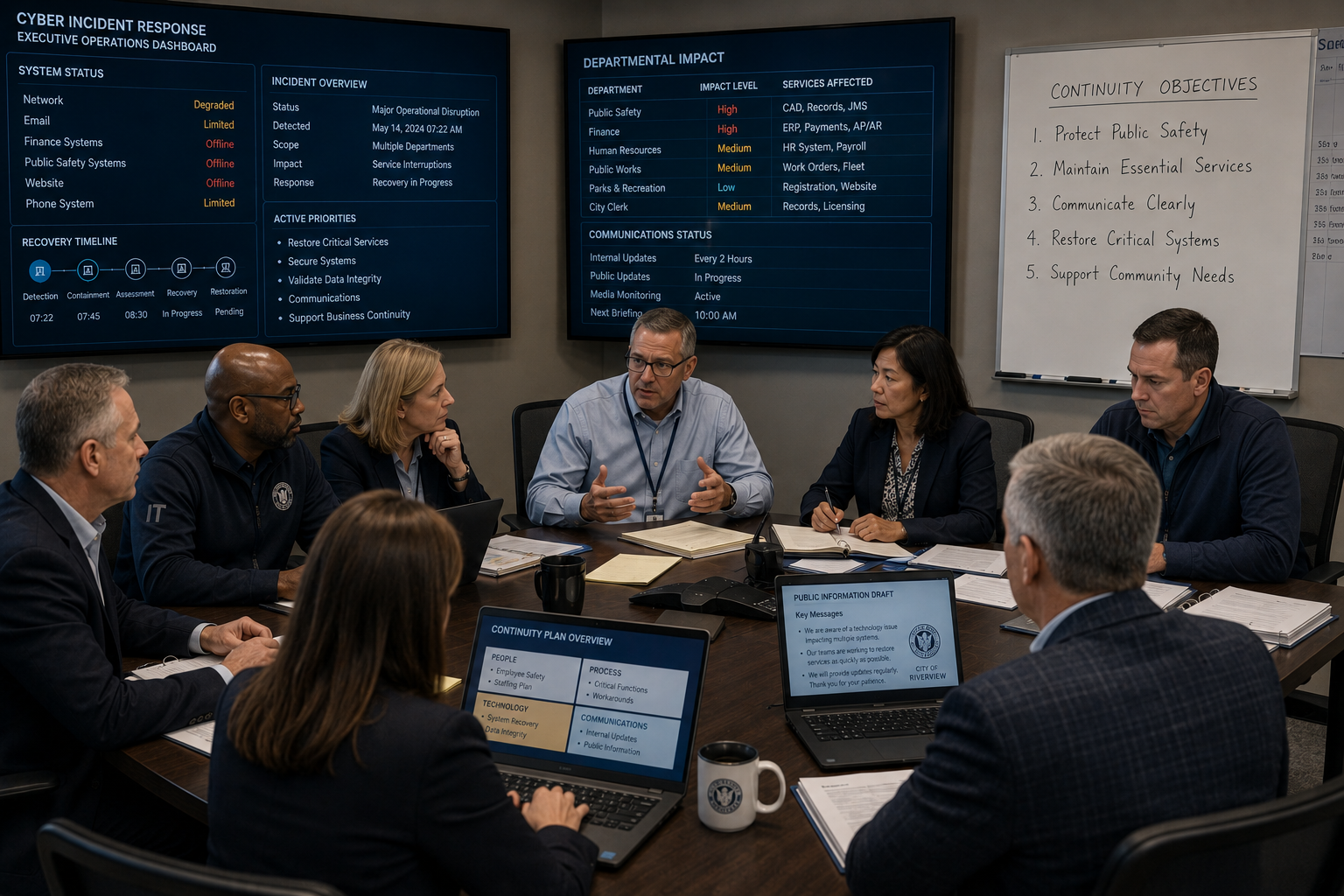
Tabletop exercises, for example, should no longer focus solely on breach detection scenarios. Mature organizations increasingly test operational continuity under prolonged restoration conditions:
- identity disruption
- SaaS outages
- vendor unavailability
- communications instability
- cloud dependency failures
- manual fallback operations
These exercises help leadership teams understand recovery sequencing before real disruption occurs.
They also expose organizational assumptions that often remain invisible during normal operations.
Many organizations discover that critical workflows exist only in cloud platforms without documented alternatives. Others discover that key operational decisions rely on a small number of individuals without delegated authority structures. Some realize that communications escalation paths are unclear or fragmented.
Operational continuity planning is therefore becoming central to cyber recovery governance.
Operational Survivability Will Define Mature Organizations
The cybersecurity conversation is steadily shifting away from simple prevention narratives.
Organizations now operate in environments where some level of disruption is increasingly inevitable. The defining question is no longer whether incidents occur.
The defining question is how effectively organizations sustain operations during recovery.
This is particularly important for municipalities and public-sector environments where operational continuity directly affects residents, public trust, and community stability. It is equally important for SMBs whose operational dependency on cloud ecosystems continues expanding each year.
Outage recovery strategy now matters as much as preventative security posture.
Organizations that mature successfully over the next several years will likely share several characteristics:
- executive-level recovery ownership
- tested continuity governance
- communications discipline
- delegated recovery authority
- restoration prioritization frameworks
- operational fallback procedures
- vendor coordination maturity
- identity recovery planning
These are leadership capabilities as much as technical capabilities.
Cyber operational resilience is becoming a governance discipline.
Evaluate operational continuity exposure, recovery sequencing gaps, communications readiness, identity dependency risk, and governance maturity across municipal and public-sector environments.
FAQ
Conclusion
Cybersecurity recovery is rapidly evolving into one of the most important governance challenges organizations face.
Technical containment still matters. Detection still matters. Prevention still matters.
But operational survivability increasingly determines whether organizations emerge from disruption with stability, trust, and continuity intact.
Recovery governance is therefore becoming more important than reactive technology accumulation alone.
Organizations that approach resilience strategically — through leadership coordination, operational continuity planning, communications maturity, and restoration governance — will be far better positioned to navigate future disruption calmly and effectively.
The future of cybersecurity maturity will not be measured solely by who prevents incidents.
It will increasingly be measured by who sustains operations, restores stability, and leads effectively through disruption.
Executive coordination is no longer adjacent to cybersecurity.
It is now a core requirement of operational resilience.
GOVERNANCE LOG
Issue Number: 038
Topic: Cybersecurity Recovery Is Now a Leadership Function
Strategic Positioning: Governance-first operational resilience and recovery leadership maturity
Risk Lens: Operational survivability, continuity coordination, communications discipline, and restoration governance
Business Alignment: Municipal leadership, public-sector modernization, SMB operational continuity, governance advisory positioning
Editorial Progression: Identity → Privilege → Detection → Response → Operational Continuity → Recovery Governance