

Everything Worked Perfectly — Until 1 Login Failed
IT Trends Weekly Issue 039 | May 24, 2026
Cloud dependency risk is becoming one of the least visible operational challenges organizations face today because it rarely announces itself the way traditional failures once did.
On Monday morning, everything appears normal.
Email is available. Internet connectivity is healthy. Dashboards show green indicators. Infrastructure monitoring suggests systems are functioning exactly as expected.
Then the help desk begins receiving calls.
A user cannot log in.
Then another.
HR cannot access records.
Finance cannot approve invoices.
Teams suddenly lose the ability to coordinate work.
Nothing appears broken.
Yet operations are beginning to slow.
Most organizations instinctively begin searching for infrastructure problems when situations like this occur. Teams review network health, server performance, and application status because those have traditionally represented the places where failures become visible.
But increasingly, the issue is not infrastructure failure.
The issue is dependency failure.
Modern environments continue becoming more interconnected while operational dependencies become increasingly difficult to identify.
Understanding infrastructure alone is no longer enough.
Understand what systems, applications, vendors, and services support critical organizational functions before hidden dependencies become operational blind spots.
Convenience Solved Complexity. It Did Not Eliminate Risk
For years organizations worked hard to reduce technical complexity. Systems moved into cloud platforms. Collaboration tools replaced local workloads. Identity services became centralized. Infrastructure footprints became smaller and easier to manage.
Those decisions produced measurable benefits. Technology became easier to maintain, easier to scale, and easier to deploy.
But an important shift occurred along the way.
Convenience solved complexity. It did not eliminate risk.
Organizations are replacing infrastructure complexity with dependency complexity.
That distinction matters because dependency failures often behave quietly. Systems themselves may continue functioning exactly as expected while the business processes depending on those systems begin slowing or stopping altogether.
Modern outages increasingly begin outside organizational boundaries.[1][2]
Why Modern Outages Behave Differently
Historically, organizations understood resilience through visible infrastructure. If critical systems failed, organizations invested in redundancy. Backup internet circuits were added. Storage replication expanded. Disaster recovery environments were established.
Those investments remain valuable.
However:
Redundancy and resilience are no longer the same thing.
Modern organizations increasingly operate within ecosystems rather than isolated technology environments.
Identity services support communication platforms.
Collaboration tools rely upon authentication systems.
Business applications rely on external APIs.
Critical workflows increasingly depend on third-party integrations.
Most of these relationships remain invisible until they stop working.[3][4]
IT Trends Weekly provides executive-focused technology intelligence designed to help leadership teams understand emerging operational realities before they become operational problems.
Leadership Often Cannot See Dependency Risk
Leadership teams frequently understand the business itself. Technology teams frequently understand systems. Yet surprisingly few organizations maintain a complete view connecting technology systems to operational outcomes.
That gap is becoming increasingly important because dependency chains are rarely created all at once. They typically develop gradually over time.
An organization adopts a cloud productivity suite. Later it adds a collaboration platform. Identity becomes centralized. Additional applications are introduced. Vendors connect systems together. Workflow integrations are enabled. Teams become more productive and processes become more efficient.
Individually, every decision makes sense.
Collectively, organizations may unknowingly create operational fragility.
A municipality may depend on centralized identity services supporting records access, permitting systems, internal communications, and operational workflows. A higher education environment may rely upon interconnected learning platforms, registration systems, administrative applications, and communication tools. Small and medium-sized organizations frequently connect customer systems, financial platforms, collaboration tools, and external vendors into a single operational ecosystem.
None of these environments are inherently flawed.
The challenge is visibility.
Leadership often sees successful business outcomes while technology teams see successful implementations. The dependency relationships underneath those successes frequently remain undocumented because there was never an obvious reason to document them.
Until disruption occurs.
Dependency failures frequently create confusion because they do not resemble traditional operational incidents.
Servers remain online.
Internet connectivity continues functioning.
Applications appear available.
Dashboards remain green.
Yet users suddenly lose the ability to perform work.
For many organizations, this becomes the first moment they realize that healthy infrastructure and healthy operations are not always the same thing.[5][6]
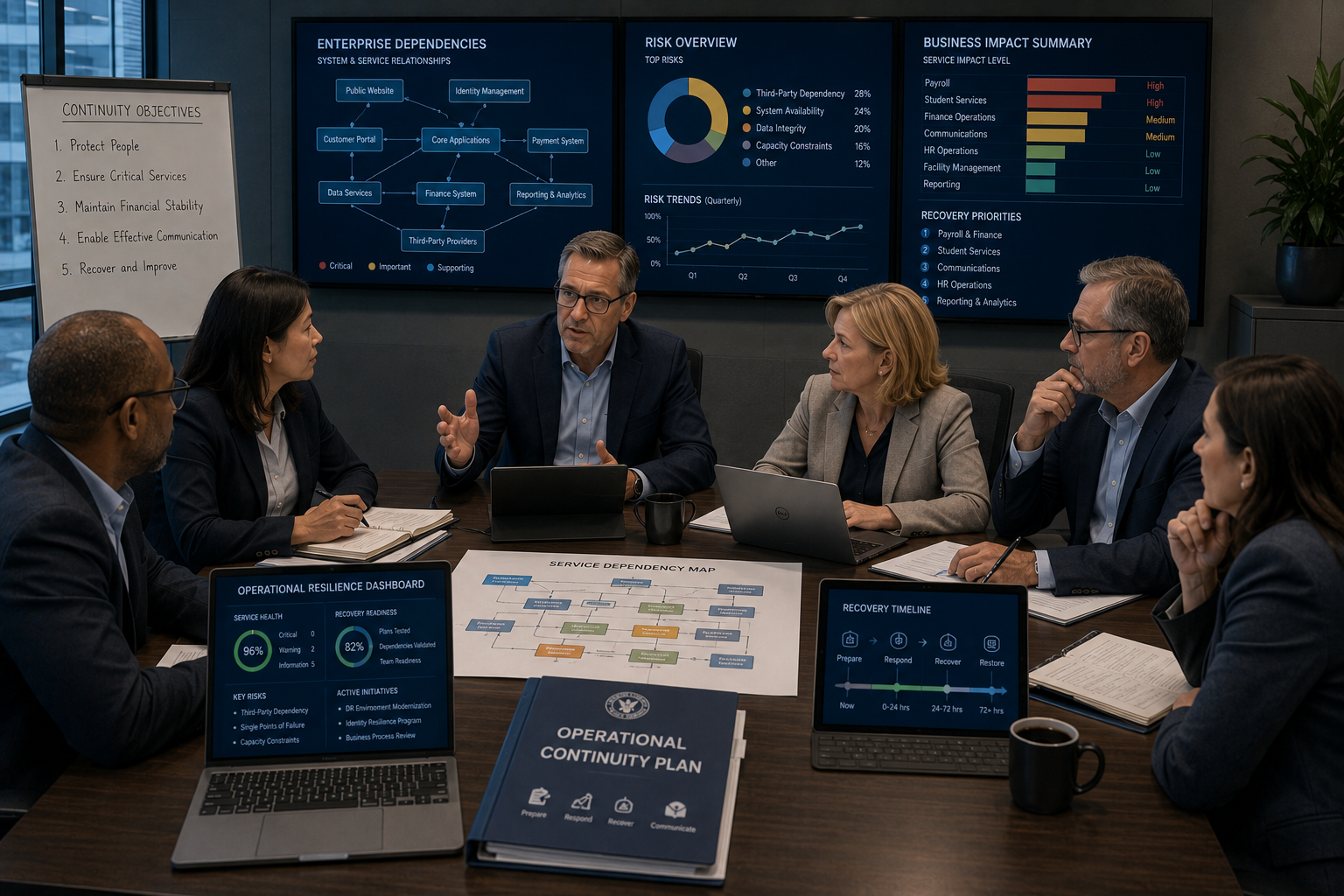
Dependency Mapping Is Becoming Governance Work
Historically, continuity planning focused heavily on disaster recovery.
Questions usually centered around restoring systems after disruption:
- How quickly can systems return?
- Where are backups stored?
- How long will infrastructure restoration require?
Those questions remain important.
But modern continuity governance increasingly asks different questions.
- What external services support critical operations?
- What manual fallback procedures exist if digital processes become unavailable?
- How will communication occur if primary collaboration platforms become inaccessible?
- Which business functions require recovery prioritization?
- Who determines restoration sequencing?
Those questions shift conversations away from technology inventories and toward operational outcomes.
That distinction matters because business restoration and technology restoration are not always identical objectives.
A system may technically recover while operations continue struggling.
An application may become available while users still lack authentication access. Infrastructure may function normally while communication pathways remain unavailable. Data may remain intact while workflows continue experiencing delays.
Technology restoration alone does not necessarily create operational resilience.
Operational continuity now depends upon understanding external dependencies.[1][4][7]
Operational resilience increasingly depends on governance maturity rather than technology accumulation alone.
Dependency visibility, recovery prioritization, and continuity planning are becoming foundational leadership functions.
Operational Survivability Is Becoming The Defining Metric
Public-sector organizations face particularly important considerations because digital systems increasingly support citizen expectations. Permitting processes, records access, communications systems, utility interactions, emergency coordination, and public-facing services frequently depend upon interconnected environments operating behind the scenes.
Citizens rarely distinguish between infrastructure failure and dependency failure.
They simply experience service disruption.
Public trust can therefore be affected by failures that never originated inside the organization itself.
That reality shifts dependency conversations beyond technology discussions and into leadership discussions.
Increasingly, organizations need visibility into:
• Identity dependency
• SaaS dependency
• Vendor dependency
• Third-party dependency risk
• Recovery prioritization
• Communication pathways
• Manual fallback procedures
• Business restoration sequencing
None of these discussions require panic.
None suggest that cloud platforms create unavoidable risk.
Modern cloud ecosystems continue delivering extraordinary value. They improve agility, reduce operational burden, and provide capabilities many organizations would struggle to build independently.
The objective is not avoiding convenience.
The objective is understanding what convenience changes.
Convenience frequently removes visible complexity while quietly introducing hidden complexity.
Operational survivability is becoming the defining cybersecurity metric.[2][3][8]
FAQ
CONCLUSION
Technology has spent years moving toward simplicity.
Infrastructure footprints became smaller. Platforms became easier to deploy. Cloud services reduced administrative overhead. Managed systems accelerated adoption and increased flexibility.
Those changes delivered meaningful value.
But resilience increasingly requires organizations to understand not only what technology simplifies, but also what technology connects.
Visibility is becoming more important than assumptions.
Governance is becoming more important than accumulation.
Resilience is becoming more important than convenience.
The organizations most prepared for future disruption may not necessarily be those with the most sophisticated infrastructure or the largest technology investments.
Increasingly, they may be the organizations with the clearest understanding of how operations actually function.
Because operational survivability rarely depends upon how much technology an organization owns.
It increasingly depends upon understanding what the organization cannot afford to lose.
Leadership ownership of operational resilience is no longer emerging strategy.
It is becoming operational necessity.
Sources
[1] NIST Cybersecurity Framework 2.0
[2] CISA Supply Chain Risk Management Resources
[3] Microsoft Digital Defense Report
[4] FEMA Continuity Guidance Circular
[5] Verizon Data Breach Investigations Report (DBIR)
[6] CIS Critical Security Controls
[8] Gartner research on operational resilience and dependency risk (subscription research portal)
GOVERNANCE LOG
Issue Number: 039
Topic: Everything Worked Perfectly — Until One Login Failed
Strategic Positioning: Dependency visibility and operational resilience maturity
Risk Lens: Hidden operational dependencies and continuity exposure
Business Alignment: Leadership awareness, continuity planning, and operational survivability
Editorial Progression:
Identity → Privilege → Detection → Response → Operational Continuity → Recovery Governance → Dependency Governance
Positioning Outcome:
This issue shifts the conversation from technology restoration toward operational survivability and establishes dependency governance as a leadership responsibility rather than solely a technical function.