

Detection Without Response Is Failure — Why Most Organizations Still Can’t Contain a Breach Fast Enough
IT Trends Weekly – Issue 036 | April 26, 2026
Incident response time is now the single most important variable determining whether a breach becomes an incident—or a disaster.
Detection Without Response Is a False Sense of Security
Most organizations have invested heavily in detection: endpoint protection, SIEM platforms, and alerting pipelines. But detection without execution is operational theater.
According to NIST, the incident response lifecycle explicitly separates detection from containment, eradication, and recovery—yet most environments stall between phases.[1]
This gap defines modern failure.
Security tools generate alerts. Teams acknowledge them. But action—containment—is delayed due to unclear ownership, missing playbooks, or lack of authority.
That delay is where damage occurs.
Stay ahead of operational risk trends → #subscribe
MTTD vs MTTR: The Metric That Actually Matters
Security programs often optimize for Mean Time to Detect (MTTD). But attackers don’t care how quickly you see them.
They care how long you let them stay.
Mean time to respond cybersecurity (MTTR) is the real control metric. According to IBM, organizations with faster containment reduce breach costs significantly, often by millions per incident.[2]
Similarly, Verizon reports that attackers frequently remain active for extended periods due to slow response—not lack of detection.[3]
Detection identifies the problem.
Response determines the outcome.
Why Containment Speed Defines Breach Severity
Containment is the moment control is regained.
CISA emphasizes rapid isolation of affected systems as the first critical action in any breach containment strategy.[4]
Every minute of delay increases:
- Lateral movement
- Data exfiltration
- System compromise scope
- Recovery complexity
In ransomware scenarios, ransomware containment time is often the difference between a single endpoint infection and full network encryption.
Containment is not a technical step—it is a governance decision executed in real time.
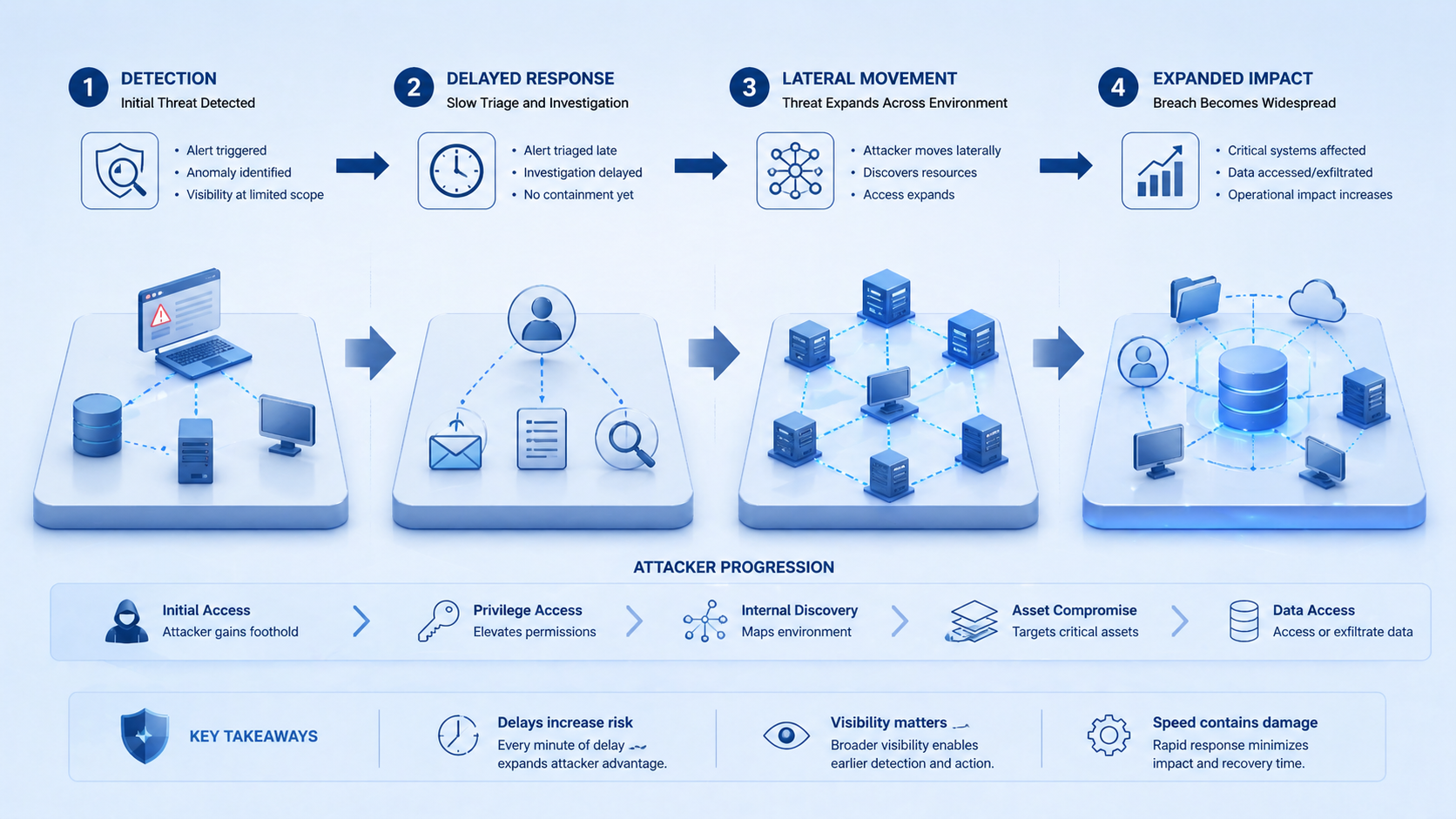
he Real Failure Pattern: Alert → Delay → Escalation → Damage
Across incident investigations—from Mandiant to Microsoft—a consistent pattern emerges:[5][6]
- Alert generated
- Analyst reviews but lacks authority
- Escalation chain delays action
- Attacker continues operating
This is not a tooling failure.
It is a security incident escalation failure.
Organizations assume escalation equals response. In reality, escalation often delays response.
Operational Gaps That Slow Response
No Defined Incident Response Plan
Without a structured framework, teams improvise. This destroys incident response plan effectiveness.
Center for Internet Security identifies formal response planning as a foundational control.[7]
No Ownership
Who can isolate a system?
Who can shut down access?
Who makes the call?
If no one knows, nothing happens.
No Containment Authority
Even when teams know what to do, they often lack permission to act.
That hesitation adds minutes. Minutes become hours.
No Testing
Tabletop exercises are not optional.
NIST explicitly recommends regular testing of response procedures to ensure execution readiness.[1]
Municipal IT Risk Assessment
If your organization cannot clearly define response ownership, containment authority, and execution timing, your response capability is not operational.
Governance Layer: Where Response Actually Lives
The incident response lifecycle is not a technical diagram—it is an operational contract.
It defines:
- Roles
- Authority
- Decision timing
- Escalation boundaries
Role Clarity
Effective environments define:
- Who detects
- Who decides
- Who executes
Without this, response stalls.
Playbooks vs Ad-Hoc Decisions
Mature environments use predefined playbooks:
- Ransomware containment
- Credential compromise
- Data exfiltration
These eliminate hesitation.
SOC Response Maturity
Microsoft emphasizes that mature SOCs integrate automation, clear workflows, and authority delegation to reduce response time.[6]
Response maturity is measured by execution speed—not tool count.
Real-World Scenario: Municipal Breach Delay
A mid-sized municipal office detects suspicious login activity.
Alert is triggered.
But:
- IT staff escalates to management
- Legal is consulted
- Leadership hesitates to disrupt services
Two hours pass.
During that time:
- Privileged credentials are reused
- Email systems are accessed
- Sensitive data is extracted
By the time containment begins, the breach has expanded beyond recovery simplicity.
This is not hypothetical—it reflects patterns consistently observed across public sector incidents.
Business Impact: Response Time Is Financial Exposure
Slow response translates directly into:
- Extended downtime
- Increased recovery costs
- Regulatory exposure
- Insurance complications
IBM links prolonged response times with significantly higher breach costs.[2]
Cyber insurance carriers increasingly evaluate incident response time and plan maturity before issuing or renewing policies.
For municipal environments, the risk extends further:
- Public trust erosion
- Operational disruption (public safety impact)
- Legal and compliance consequences
The Execution Gap: Where Most Response Strategies Break Down
Even organizations that have documented procedures often fail in execution.
This is the difference between having an incident response plan and achieving real incident response plan effectiveness.
The gap shows up in three specific ways:
1. Decision Latency
In many environments, detection is automated—but response requires human approval.
This introduces friction:
- Analysts hesitate to isolate systems
- Managers delay decisions to assess business impact
- Leadership prioritizes uptime over containment
According to CISA, delayed containment significantly increases the likelihood of lateral movement and data exfiltration.[4]
The result is predictable: mean time to respond cybersecurity increases—not because teams don’t know what to do, but because they cannot act fast enough.
2. Tool-to-Action Disconnect
Security stacks are increasingly complex:
- SIEM
- EDR
- Identity monitoring
- Cloud logging
But tools don’t respond—people do.
Microsoft highlights that organizations with high SOC response maturity integrate detection tools directly into automated or semi-automated response workflows.[6]
Without that integration:
- Alerts pile up
- Analysts triage instead of act
- Containment becomes reactive instead of immediate
This is where many breach containment strategies fail—not at detection, but at execution.
3. Lack of Pre-Authorized Actions
In high-functioning environments, certain actions are pre-approved:
- Isolate endpoint immediately
- Disable compromised account
- Block suspicious IPs
In low-maturity environments, every action requires escalation.
That delay is where attackers win.
This is especially critical in ransomware scenarios, where ransomware containment time directly determines whether encryption spreads beyond initial systems.
Why Playbooks Fail Without Operational Authority
Many organizations believe that documented playbooks solve the problem.
They don’t.
Playbooks without authority are just documentation.
The incident response lifecycle defined by NIST requires not just defined steps—but the ability to execute them immediately.[1]
Effective playbooks must include:
- Trigger conditions (what initiates action)
- Immediate containment steps
- Defined authority (who can act without approval)
- Escalation boundaries (when leadership is involved)
Without these elements, response becomes interpretive instead of procedural.
And interpretation slows everything down.
Containment as a Business Decision, Not a Technical One
One of the most overlooked realities in cybersecurity is this:
Containment is not a technical decision—it is a business decision executed through technical means.
When a system is isolated:
- Operations may be disrupted
- Revenue may be impacted
- Public services may be interrupted
This is why response often stalls—organizations hesitate to act.
But delaying containment doesn’t avoid impact.
It amplifies it.
According to IBM, organizations that contain breaches faster experience significantly lower financial and operational damage.[2]
The choice is not between disruption and stability.
It is between:
- Controlled disruption now
- Uncontrolled disruption later
The Insurance Reality: Response Time Is Now Underwriting Risk
Cyber insurance carriers are no longer evaluating organizations based solely on controls like MFA or backups.
They are evaluating:
- Incident response lifecycle maturity
- Mean time to respond cybersecurity
- Documented containment procedures
Failure to demonstrate effective response capability increasingly results in:
- Higher premiums
- Reduced coverage
- Denied claims
This aligns with trends observed in breach reporting and risk analysis from Verizon and Mandiant, where response delays directly correlate with increased impact.[3][5]
In other words:
Your incident response time is now part of your financial risk profile.
FAQ
Conclusion
incident response time is not a technical metric—it is a governance outcome.
Detection identifies risk.
Response controls it.
Organizations that fail to operationalize response:
- Delay containment
- Increase damage
- Lose control
The difference between disruption and disaster is measured in minutes.
Cybersecurity Governance & Incident Readiness
If your environment cannot contain a breach immediately, your risk posture is incomplete.
Build response capability before it is tested in production.
Sources
[1] NIST – https://nvlpubs.nist.gov/nistpubs/SpecialPublications/NIST.SP.800-61r2.pdf
[2] IBM – https://www.ibm.com/reports/data-breach
[3] Verizon – https://www.verizon.com/business/resources/reports/dbir/
[4] CISA – https://www.cisa.gov/stopransomware
[5] Mandiant – https://www.mandiant.com/resources/m-trends
[6] Microsoft – https://www.microsoft.com/security/blog/
[7] Center for Internet Security – https://www.cisecurity.org/controls
GOVERNANCE LOG
Issue: 036
Topic: Detection vs Response — Containment Speed
Strategic Positioning: Identity → Privileged Access → Detection → Response (progression continues toward dwell time reduction)
Risk Lens: Time-to-response as primary impact driver
Business Alignment: Operational readiness, insurance alignment, municipal risk mitigation