

Identity Has Become the Perimeter — 5 Critical Gaps Most Organizations Miss
Identity is the new security perimeter, but most organizations are still operating as if the network boundary defines security.
That assumption is no longer just outdated — it is operationally dangerous.
Cloud adoption, remote work, SaaS sprawl, and API-driven ecosystems have dissolved traditional perimeters. Users, devices, and applications now operate outside of any centralized network boundary. As a result, identity — not location — determines access, trust, and risk exposure.
This is not a theoretical shift. Both NIST and CISA explicitly anchor modern security frameworks in identity-centric models, particularly within Zero Trust architectures.[1][2]
Yet despite this guidance, most organizations have not operationalized identity as a control plane. Instead, identity remains fragmented across systems, inconsistently enforced, and poorly governed.
The Perimeter Didn’t Disappear — It Moved
Most organizations still think in terms of “inside vs outside.”
That mental model is the root of the problem.
The perimeter did not disappear — it shifted upward into the identity layer.
In practical terms:
- Your firewall no longer determines access
- Your network segmentation no longer defines trust
- Your VPN no longer guarantees security
Instead:
- Identity determines access
- Policy determines trust
- Context determines risk
This shift is explicitly defined in the NIST Zero Trust Architecture guidance.[1]
And reinforced by CISA.[2]
Organizations that fail to internalize this shift continue investing in perimeter controls that no longer enforce real security boundaries.
Why Organizations Fail
The failure is not awareness — it is execution.
Most IT leaders understand that identity is critical. But operationalizing it requires a level of discipline that many organizations have not yet achieved.
Three systemic gaps consistently emerge:
1. Identity Exists, But It Is Not Governed
Directories exist. Accounts exist. Authentication exists.
But governance — the lifecycle management of identities — is often missing.
According to CIS, ineffective identity lifecycle controls are a leading contributor to unauthorized access incidents.<sup>[3]</sup>
Accounts are rarely:
- Deprovisioned in real time
- Aligned to job roles
- Audited for privilege drift
This creates a silent expansion of access over time.
2. MFA Is Deployed — But Not Effective
Many organizations report “MFA enabled,” yet still experience credential-based attacks.
Why?
Because not all MFA is equal.
Microsoft reports that while MFA reduces risk significantly, phishing-resistant MFA is now required to counter modern attack techniques.[4]
Legacy MFA methods (SMS, push fatigue) are routinely bypassed.
The issue is not adoption — it is control quality.
3. Conditional Access Is Underutilized
Conditional access is where identity becomes a true perimeter.
But most environments:
- Use basic allow/deny rules
- Lack risk-based enforcement
- Do not integrate device posture
This results in identity being authenticated — but not evaluated.
4. Privileged Access Is Not Segmented
Administrative access remains one of the highest-risk exposure points.
The FBI continues to identify credential abuse and privilege escalation as primary attack vectors in ransomware incidents.[5]
Yet many environments still:
- Use standing admin privileges
- Lack just-in-time elevation
- Do not monitor privileged sessions
If your organization has not mapped identity controls across MFA, access policies, and privilege management, you likely have invisible exposure.
Start with a structured assessment
Operationalizing Identity
Operationalizing identity means transforming it from a passive directory into an active enforcement layer.
This requires aligning identity across four core domains:
1. Authentication Strength
Not all authentication methods provide equal assurance.
Modern guidance from NIST emphasizes phishing-resistant MFA as a baseline control.[1]
This includes:
- FIDO2 security keys
- Certificate-based authentication
- Hardware-backed credentials
2. Access Context
Identity alone is insufficient without context.
Access decisions must evaluate:
- Device compliance
- User risk signals
- Geographic anomalies
- Session behavior
CISA emphasizes continuous evaluation — not one-time authentication — as a requirement for Zero Trust maturity.[2]
3. Identity Lifecycle Management
Identity must reflect reality at all times.
This means:
- Automated provisioning
- Immediate deprovisioning
- Role-based access assignment
Without lifecycle enforcement, identity becomes stale — and therefore vulnerable.
4. Privilege Governance
Privilege must be:
- Minimized
- Temporary
- Auditable
CIS benchmarks emphasize least privilege and separation of duties as foundational identity controls.[3]
Why Identity Programs Stall in Execution
Even when organizations commit to identity-first security, progress often stalls.
This is not a tooling problem — it is a governance problem.
Three execution barriers show up consistently:
1. Identity Ownership Is Undefined
No single team owns identity end-to-end.
- IT manages directories
- Security manages policies
- HR manages onboarding
Without ownership, identity becomes fragmented.
2. Controls Are Implemented Without Validation
Organizations deploy:
- MFA
- Conditional access
- Privileged controls
But never validate:
- Are policies enforced consistently?
- Are exceptions documented?
- Are controls audited?
CIS explicitly emphasizes continuous validation as part of identity control maturity.[3]
3. Identity Is Not Treated as Critical Infrastructure
Identity systems are often:
- Lightly monitored
- Poorly documented
- Not included in incident response planning
Yet Microsoft continues to report that identity compromise is a primary breach vector.[4]
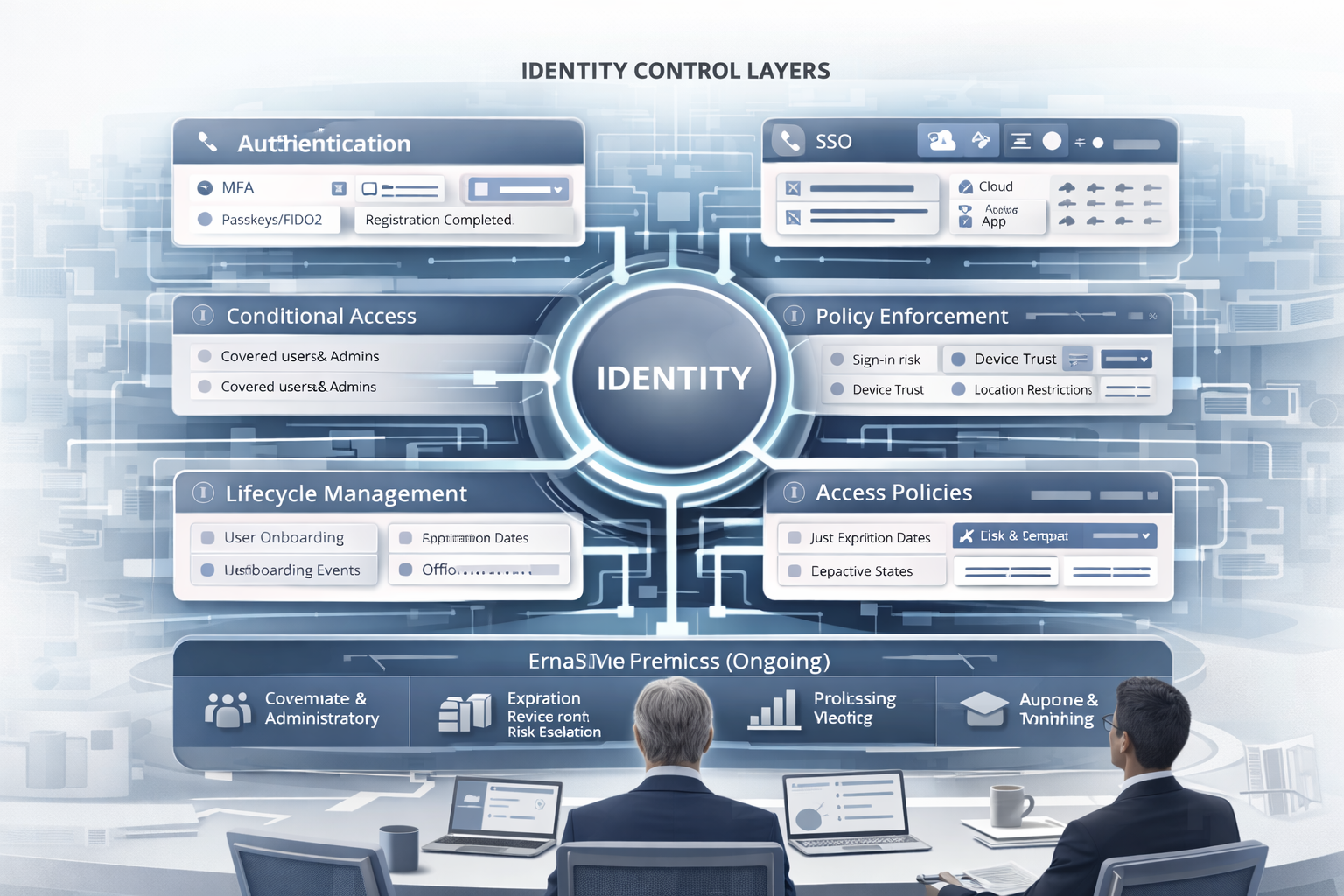
Control Framework
To operationalize identity, organizations must align to a structured control model.
This is where most environments break down — not because controls are unknown, but because they are not integrated.
A governance-aligned identity framework should include:
Identity Control Stack
- Authentication Layer: Phishing-resistant MFA
- Policy Layer: Conditional access with risk scoring
- Lifecycle Layer: Automated identity provisioning
- Privilege Layer: Just-in-time administrative access
- Monitoring Layer: Identity-based anomaly detection
This aligns directly with Zero Trust principles defined by NIST and reinforced by Microsoft’s identity-first security model.[1][4]
This is where organizations begin to truly understand that identity is the new security perimeter, not just a supporting system.
Execution Roadmap
Execution requires sequencing — not tool deployment.
A practical roadmap for organizations under 100,000 population:
Phase 1: Baseline Identity Inventory
- Identify all identity sources
- Map privileged accounts
- Audit inactive users
Phase 2: MFA Hardening
- Eliminate legacy MFA methods
- Deploy phishing-resistant options
Phase 3: Conditional Access Expansion
- Implement risk-based policies
- Enforce device compliance
Phase 4: Privilege Reduction
- Remove standing admin rights
- Implement just-in-time elevation
Phase 5: Lifecycle Automation
- Integrate HR systems
- Automate onboarding/offboarding
Without this level of execution, identity is the new security perimeter remains a concept rather than an operational reality.
What Maturity Actually Looks Like in Practice
An operational identity program is not defined by tools — it is defined by consistency.
At maturity, organizations demonstrate:
- Every user authenticated with phishing-resistant MFA
- Every access request evaluated against policy and context
- Every privileged action logged and reviewable
- Every identity lifecycle event automated
The FBI continues to highlight identity abuse and credential theft as primary entry points in ransomware campaigns.[5]
This is the measurable outcome of identity immaturity.
This is what it means when identity is the new security perimeter in practice.
Get governance-level breakdowns like this every week:
FAQ
Conclusion
Organizations that recognize that identity is the new security perimeter but fail to operationalize it remain exposed in ways that are not immediately visible.
This is the core risk.
Identity is no longer a supporting system — it is the control plane.
And until it is treated that way — governed, enforced, and continuously evaluated — security remains incomplete.
This is the operational reality organizations must accept as identity is the new security perimeter.
Ready to operationalize identity across your environment?
Start here:
Or talk to us directly:
Sources
[1] NIST SP 800-207 — Zero Trust Architecture
[2] CISA Zero Trust Maturity Model (2023)
[3] CIS Critical Security Controls v8
[4] Microsoft — Identity Security & MFA Effectiveness Reports
[5] FBI Internet Crime Report (IC3)
Issue Number: 033
Topic: Identity as the Security Perimeter
Strategic Positioning: Identity-first security as foundational governance layer
Risk Lens: Credential abuse, privilege escalation, policy gaps
Business Alignment: Enables Zero Trust adoption, cyber insurance readiness, and operational security maturity