

Cyber Insurance Is Now Driving Your Security Stack (Whether You Realize It or Not)
The cyber insurance security stack is no longer shaped solely by internal IT decisions. Most organizations still talk about cyber insurance as if it sits downstream from security: buy the policy, answer the questionnaire, hope the premium stays reasonable, and move on. In 2026, that view is outdated. The more accurate picture is that insurance underwriting now acts as a market-based governance force, pushing organizations toward specific control families, documentation practices, and operating disciplines that already align with NIST, CISA, Microsoft, and broader regulatory expectations.[1][2][4][8] Whether leaders explicitly acknowledge it or not, coverage terms, exclusions, sublimits, and renewal scrutiny are helping decide what gets funded first in the security stack. This is where the cyber insurance security stack becomes a governance decision, not just a technical one.
How the Cyber Insurance Security Stack Now Shapes Controls
Cyber insurance has become more than a transfer mechanism for financial loss. NAIC notes that cyber coverage is highly customized, not bundled into a simple one-size-fits-all form, and GAO has described the market as evolving under growing cyber risk and uncertainty.[8][10] That matters because customized coverage means underwriters increasingly care about how an organization actually operates, not just what tools it claims to own.
In practice, that has moved security conversations away from broad statements like “we have antivirus” or “we use Microsoft 365” and toward evidence-backed questions: Is multifactor authentication enforced for administrators? Are risky sign-ins restricted? Are backups offline or otherwise resilient to ransomware? Is there an incident response process that leadership understands? Can the organization show that controls are not merely purchased, but governed?[3][4][5][7]
That shift mirrors NIST CSF 2.0. NIST explicitly places Govern at the front of the framework, stating that cybersecurity risk management strategy, expectations, and policy must be established, communicated, and monitored.[1] The underwriting signal is clear: insurers are increasingly interested in whether an organization can demonstrate managed risk, not just deployed technology.
Need a baseline before renewal season?
Start with our Municipal IT Risk Assessment to identify the control gaps, governance weaknesses, and documentation issues most likely to create friction during cyber insurance renewal.
What underwriting is really measuring
Many renewal forms look like procurement paperwork, but functionally they are maturity tests. They tend to concentrate on the same few domains because those domains are strongly tied to actual attack paths and loss severity.
The first domain is identity. Microsoft states that more than 99.9% of compromised accounts do not use MFA.[3] Microsoft also describes Conditional Access as its Zero Trust policy engine, capable of using user, device, application, location, and risk signals to require MFA, block legacy authentication, require compliant devices, and restrict risky sign-ins.[4]That is why identity questions now feel so pointed: insurers have learned that “MFA exists somewhere” is not the same as “identity risk is governed.”
The second domain is ransomware resilience. CISA’s StopRansomware guidance stresses maintaining offline, encrypted backups of critical data and regularly testing backup availability and integrity in disaster recovery scenarios.[5] CISA also continues to emphasize foundational protections such as MFA, strong password management, and routine backups as minimum expectations across sectors.[6] Underwriters are not being arbitrary when they ask about immutable storage, test frequency, privileged access separation, or restoration evidence. They are asking about the controls that determine whether a ransomware event becomes a disruption or a crisis.
The third domain is operational readiness. NIST’s updated incident response guidance says incident response is a critical part of cybersecurity risk management and should be integrated into broader risk management practices.[7] That is why questionnaires increasingly ask who owns incident response, whether outside counsel or forensic firms are identified, how quickly leadership can escalate, and whether the organization has tested communications.
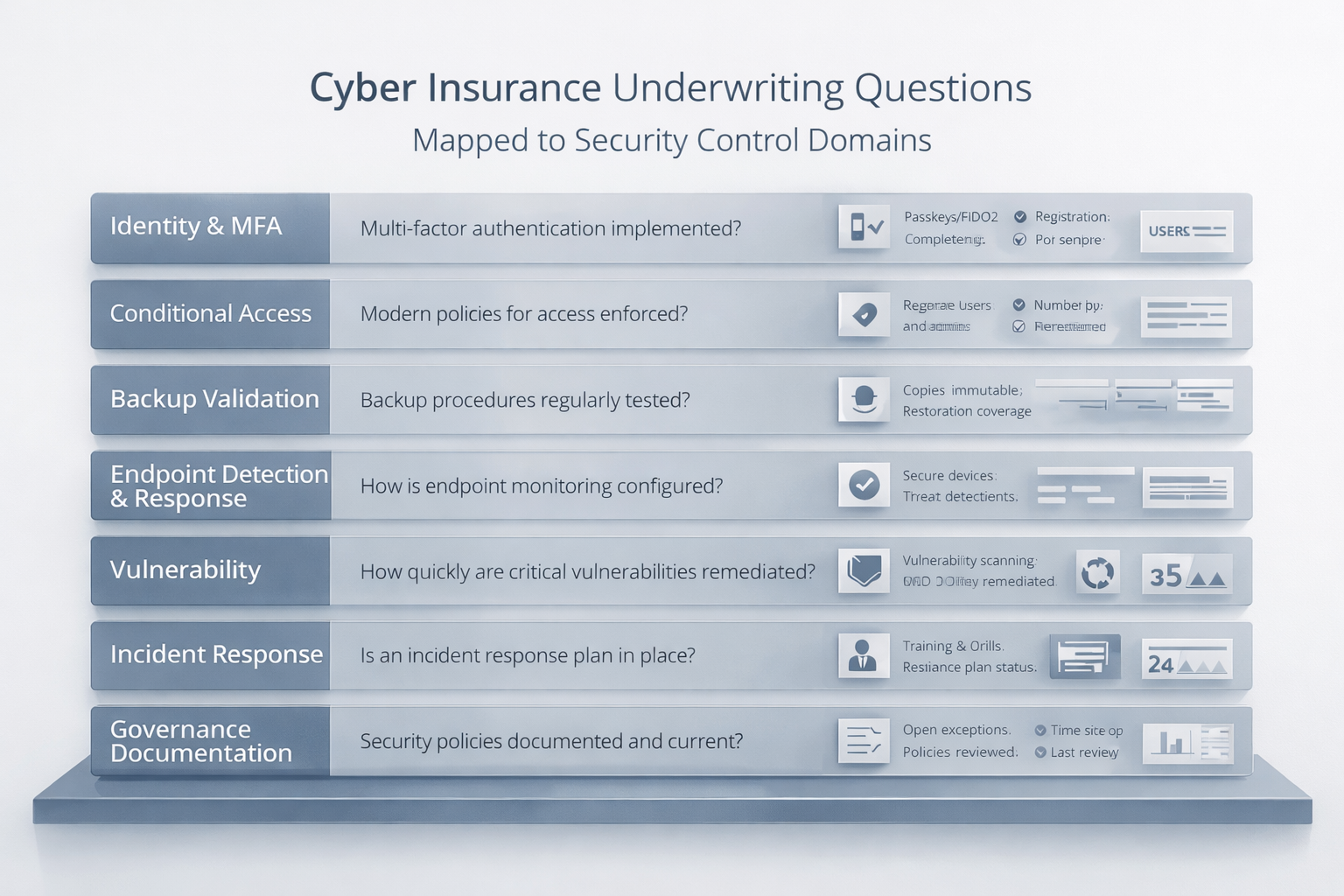
This is also where many smaller organizations get caught off guard. They assume the insurance carrier is asking for a tool list, when what is really being tested is control reliability. A checkbox answer may get the application submitted, but during renewal or claim review, weak implementation details can become a business problem.
Governance, not gadget buying, is the real differentiator
The wrong response to insurer pressure is panic buying. The right response is governance-led stack design.
NIST’s small business guidance is especially useful here because it reminds organizations that the framework is voluntary, flexible, and intended to help them understand, assess, prioritize, and communicate cybersecurity efforts regardless of size or maturity.[2] For organizations under 100,000 population, that matters. Most do not need a sprawling enterprise security portfolio. They need a disciplined model for deciding which controls are mandatory, which are compensating, which are deferred, and who approves exceptions.
That is where leadership teams should slow down and ask five governance questions. What controls are now non-negotiable for coverage viability? Which existing products are under-configured rather than absent? Which dependencies sit with third parties or MSPs? Which control assertions can be evidenced today? And which risks are being implicitly accepted because nobody formally owns them?[1][7][9]
NAIC’s Insurance Data Security Model Law brief reinforces the same pattern from the regulatory side: information security programs should be based on risk assessment, include designated responsibility, and cover oversight of third-party service providers.[9] That is not identical to underwriting, but it reinforces the same operating principle. Security maturity is increasingly measured through accountability, risk assessment, and oversight, not through product volume.
If your tools are in place but your operating model is not, review our Cybersecurity Governance page. It is the governance layer—not just the product stack—that determines whether controls hold up under renewal scrutiny.
Why this matters for organizations under 100,000 population
Smaller municipalities, nonprofits, utilities, and regional businesses often face the hardest version of this problem. They operate with lean staff, inherited technology, partial documentation, and shared responsibilities across vendors, internal admins, and leadership. Yet the threat environment is not scaled down for them. FBI IC3 reported 263,455 cyber threat complaints in 2024 with $1.571 billion in losses, 4,878 complaints tied to critical infrastructure, and 67 new ransomware variants recognized that year.[11]
For that reason, cyber insurance pressure can actually be useful when treated correctly. It creates external urgency for controls that should already exist: privileged account discipline, modern authentication, tested backup recovery, documented incident response, and a clearer understanding of what the organization can prove.[3][5][7][11]
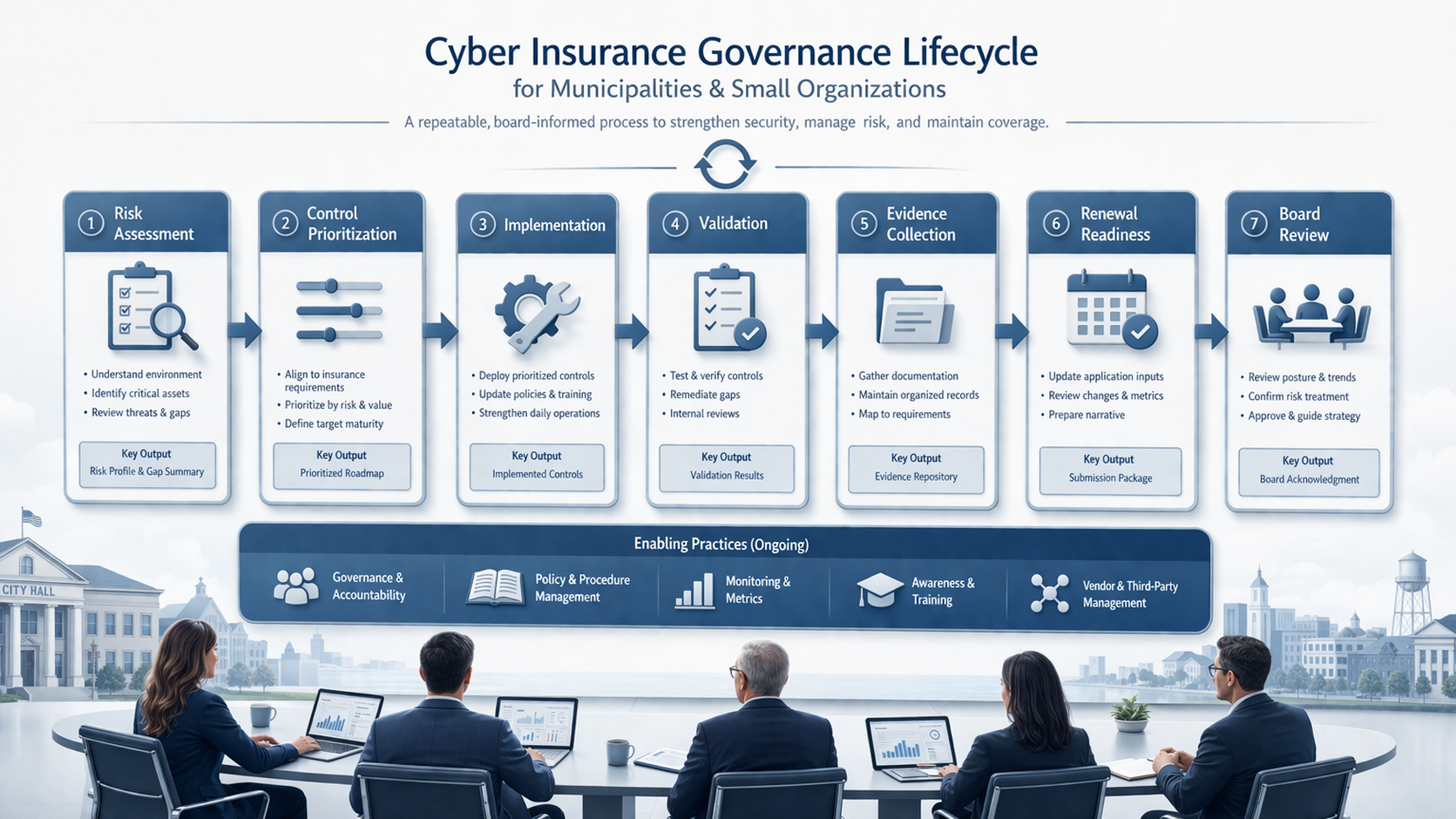
What smaller organizations cannot afford is scattershot remediation. Buying EDR while administrators still share accounts, or tightening phishing filters while backups remain untested, may improve the appearance of security without materially improving insurability or resilience. NIST CSF 2.0’s Govern-first structure exists for exactly this reason: prioritization has to come before tooling sprawl.[1][2]
A practical renewal-readiness checklist
Before the next renewal, leadership should treat the application like an internal audit prompt.
Confirm where MFA is truly enforced, especially for administrators, remote access, privileged workflows, and cloud services.[3][4] Validate whether legacy authentication is blocked or still quietly allowed.[4] Review backup architecture and run a real restore exercise, not just a backup job report.[5] Make sure incident response roles, outside contacts, escalation paths, and reporting expectations are documented and current.[7] Reconcile vendor dependencies, because third-party oversight remains part of modern security governance and regulatory expectation.[9]
Most importantly, create a plain-language evidence set. Underwriters, auditors, boards, and executive teams all benefit when the organization can show a current control inventory, policy ownership, exception log, recent validation dates, and a short narrative explaining where the environment is strong, where it is improving, and where risk is still accepted. That is how security stops being a collection of products and becomes a governed business function.[1][2][9]
Need help preparing for renewal or board review? Use our Contact page to schedule a governance-focused security assessment that aligns technical controls, documentation, and renewal readiness.
FAQ
Conclusion
Cyber insurance is no longer sitting quietly in the background of the security program. It is shaping how organizations prioritize identity, backups, incident response, vendor oversight, and documentation. For disciplined leaders, that pressure can be productive. It can help turn vague security ambition into governed action. But only if the organization treats underwriting signals as prompts for stronger governance, not excuses for reactive product buying. Organizations that understand the cyber insurance security stack early will make better decisions than those reacting at renewal. In 2026, the winning posture is clear: design the stack around managed risk, validated controls, and executive accountability before the renewal packet forces the issue.[1][4][5][9]
Want to strengthen renewal readiness before your next application cycle? Review our Municipal IT Risk Assessment and Cybersecurity Governance resources, then reach out through our Contact page for a structured control and documentation review.
Get IT Trends Weekly in your inbox. Subscribe below for weekly, governance-first analysis built for IT leaders, municipal decision-makers, and organizations that need practical clarity without the noise.
Sources
[1] NIST, The NIST Cybersecurity Framework (CSF) 2.0, Feb. 26, 2024.
[2] NIST, Cybersecurity Framework 2.0: Small Business Quick-Start Guide, 2024.
[3] Microsoft, Security at your organization: Multifactor authentication (MFA) statistics, updated Jan. 22, 2025.
[4] Microsoft Learn, Microsoft Entra Conditional Access: Zero Trust policy engine, updated Mar. 2026.
[5] CISA, #StopRansomware Guide, 2025.
[6] CISA, Cybersecurity Performance Goals (CPGs) / CPG Checklist and related guidance, accessed 2026.
[7] NIST, SP 800-61r3: Incident Response Recommendations and Considerations for Cyber Risk Management, Apr. 2025.
[8] NAIC, Insurance Topics: Cybersecurity, updated May 9, 2024.
[9] NAIC, The NAIC Insurance Data Security Model Law, Aug. 2025.
[10] GAO, Cyber Insurance: Action Needed to Assess Potential Federal Response to Catastrophic Attacks, Jun. 21, 2022.
[11] FBI IC3, 2024 IC3 Annual Report, Dec. 2024.
Issue number: 032
Topic: Cyber Insurance Is Now Driving Your Security Stack (Whether You Realize It or Not)
Strategic positioning: Reframes cyber insurance from back-end financial instrument to front-end governance and control-prioritization force
Risk lens: Renewal scrutiny, control evidence, ransomware resilience, identity governance, and incident response readiness
Business alignment: Helps IT leaders and municipal decision-makers align security spend, documentation, and operating discipline with insurability, resilience, and executive accountability