

Privileged Access Is Your Largest Hidden Risk — And Most Environments Still Treat It Casually
IT Trends Weekly — Issue 034 (April 12, 2026)
Privileged access risk is no longer a technical issue — it is a governance failure
Privileged access risk is now the single most consequential weakness in modern IT environments, yet most organizations continue to treat it as a background technical concern rather than a primary governance priority.
Over the past decade, security strategy has shifted toward identity. But what many organizations still fail to operationalize is this:
Identity gets you in. Privilege determines how far you can go.
According to CISA, credential abuse and privilege escalation remain among the most common techniques used in successful attacks.[1] Once an attacker gains initial access—often through phishing or compromised credentials—the real damage begins when they encounter poorly controlled privileged accounts.
This is where breaches expand from incidents into disasters.
Why privileged access has become the primary breach amplifier
Most organizations focus heavily on preventing initial access. But attackers don’t need much:
- A compromised user account
- A reused password
- A session token
From there, the objective is simple: gain elevated access.
Guidance from NIST emphasizes that privileged accounts must be tightly controlled because they provide direct access to critical systems and data.[2]
Yet in practice, environments often include:
- Standing global administrator accounts
- Domain admin privileges assigned permanently
- Shared admin credentials across teams
- Service accounts with excessive permissions
Each of these represents not just risk—but unbounded risk.
Real-world failure patterns organizations still haven’t corrected
Despite years of awareness, the same patterns continue to appear in breach investigations:
1. Standing Administrative Access
Users retain elevated permissions indefinitely instead of receiving them temporarily.
2. Shared Credentials
Multiple staff using the same admin account eliminates accountability entirely.
3. Lack of Privileged Session Logging
No visibility into what administrators actually do once elevated.
4. Overprivileged Service Accounts
Applications running with far more access than required.
5. No Segmentation Between User and Admin Identities
Same identity used for both daily work and administrative control.
The Center for Internet Security Critical Security Controls explicitly call out the need to manage and audit administrative privileges as a foundational control.[3]
Yet most smaller organizations—and many municipalities—have not implemented these controls in a structured way.
The connection between identity compromise and lateral movement
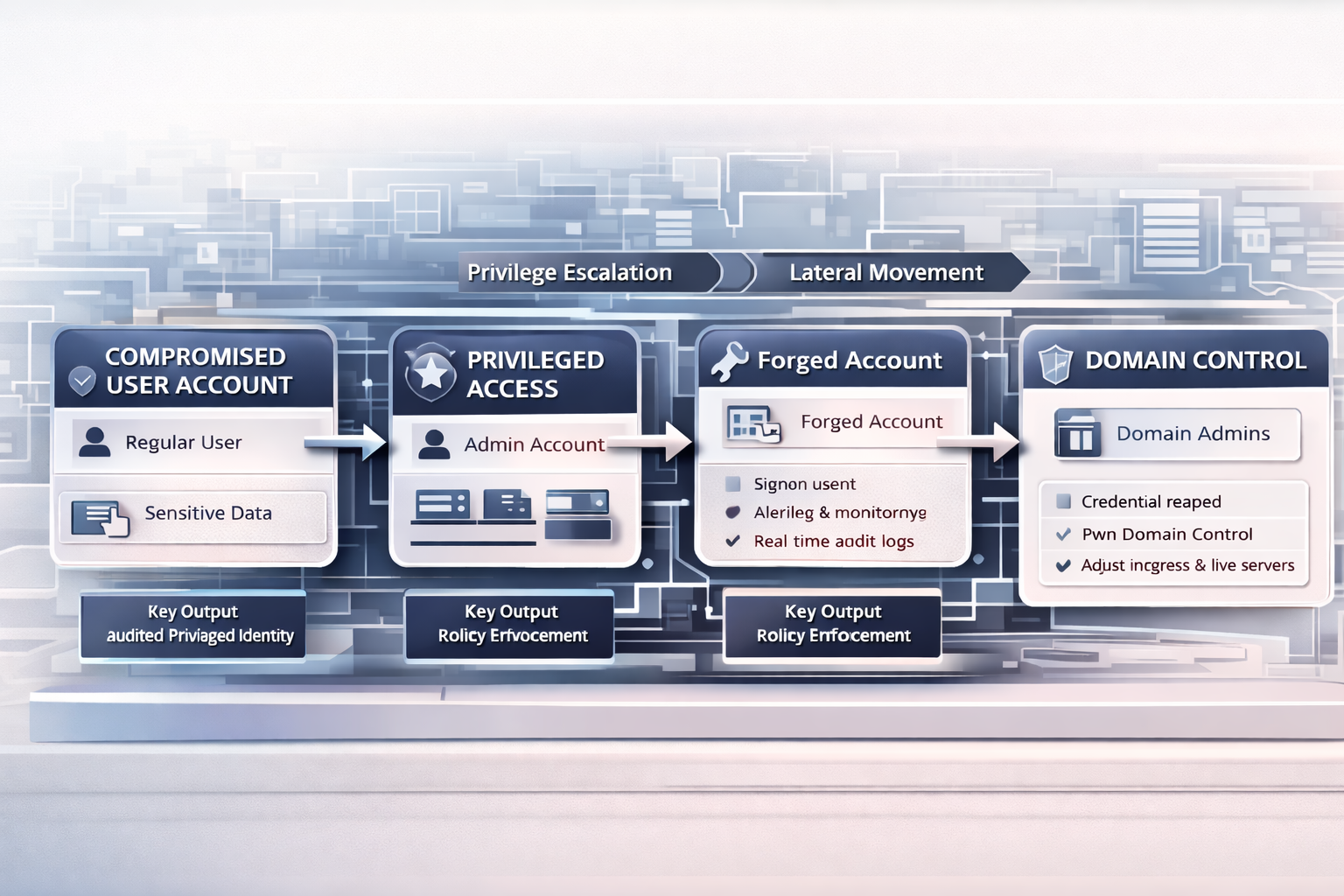
Once privilege is obtained, attackers rarely act immediately. Instead, they move laterally.
Lateral movement allows attackers to:
- Discover additional systems
- Harvest more credentials
- Escalate privileges further
- Avoid detection
The FBI has repeatedly warned that ransomware groups rely heavily on lateral movement after initial compromise.[4]
This is where privileged access becomes dangerous:
Without strict controls, a single compromised account can lead to:
- Domain-wide control
- Backup system compromise
- Security tool disablement
- Full operational shutdown
This is not theoretical. It is the standard attack path.
Why MFA does NOT solve privileged access risk
Many organizations believe they are secure because they have deployed MFA.
This is a dangerous misconception.
While MFA is critical, Microsoft has stated that MFA reduces risk of compromise—but does not eliminate it, particularly in cases involving:
- Token theft
- Session hijacking
- Phishing-resistant bypass techniques[5]
Once an attacker is inside with valid authentication, MFA is no longer the barrier.
Privilege is.
If privileged access is not tightly controlled, MFA simply delays—not prevents—escalation.
Governance gap vs. tool gap — the real problem
Most organizations assume they need new tools:
- Privileged Access Management (PAM) platforms
- Identity governance suites
- Endpoint privilege tools
But the reality is more uncomfortable:
The failure is not technological. It is governance-related.
Organizations often already have:
- Microsoft 365
- Active Directory / Entra ID
- Logging capabilities
What they lack is:
- Defined privileged access policies
- Role-based access structures
- Approval workflows
- Audit requirements
- Executive oversight
CISA and NIST both emphasize that access control must be governed, not just implemented.[1][2]
Without governance, tools become unused features.
If your organization has not formally assessed privileged access controls, this is where most breach exposure exists.
→ Start with a structured review:
→ Or evaluate your governance posture:
What a governed privileged access model actually looks like
To reduce privileged access risk, organizations must move toward a structured model:
1. Eliminate Standing Privileges
Adopt just-in-time (JIT) access wherever possible.
2. Separate User and Admin Identities
No user should perform admin tasks with their primary account.
3. Enforce Role-Based Access Control (RBAC)
Privileges must align strictly to roles—not individuals.
4. Require Approval Workflows
Privilege elevation should require authorization.
5. Log and Monitor All Privileged Activity
Every privileged action must be auditable.
6. Protect Privileged Accounts with Stronger Controls
Phishing-resistant MFA, conditional access, and device trust.
7. Regularly Review and Revoke Access
Privilege creep is one of the most common risk drivers.
These are not advanced capabilities. They are baseline governance expectations.
FAQ — Privileged Access and Risk
Privileged access is where breaches either stop—or spread.
If this layer is not controlled, everything above it is exposed.
Stay ahead of evolving risks:
Conclusion
Privileged access risk is the defining security challenge most organizations still underestimate.
Identity may be the perimeter—but privilege determines impact.
Until privileged access is governed with the same rigor as identity, breaches will continue to escalate from isolated incidents into full operational failures.
This is not a future problem.
It is already happening.
SOURCES
[1] CISA — Credential Access and Privilege Escalation Guidance
[2] NIST SP 800-53 / Access Control Framework
[3] Center for Internet Security Critical Security Controls v8
[4] FBI Ransomware Threat Reports
[5] Microsoft Identity Security and MFA Effectiveness Research
Issue Number: 034
Topic: Privileged Access Risk and Lateral Movement Control
Strategic Positioning: Extends identity security into privilege governance layer
Risk Lens: Breach amplification via privilege escalation and lateral movement
Business Alignment: Reduces operational, financial, and insurance exposure through access governance control