

Cyber Insurance Questionnaires in 2026 — Why Most Organizations Answer Them Wrong
Cyber insurance has rapidly shifted from a simple financial safety net into a technical governance audit disguised as an insurance form.
In 2026, insurers no longer treat cyber coverage as a generic business policy. Instead, underwriters now expect organizations to demonstrate operational cybersecurity controls — often through detailed questionnaires that probe multi-factor authentication (MFA), endpoint detection and response (EDR), backup validation, incident response planning, and governance oversight.
Unfortunately, many organizations — particularly municipalities and small-to-mid-sized entities — still approach these questionnaires as administrative paperwork rather than technical declarations of fact.
That mistake is increasingly expensive.
According to research from the National Association of Insurance Commissioners, cyber insurers have tightened underwriting requirements significantly since 2021 due to escalating ransomware claims and systemic cyber risk exposure.[1] Insurers now routinely deny claims or adjust payouts if questionnaire answers misrepresent actual security controls.
Meanwhile, the Cybersecurity and Infrastructure Security Agency continues to warn that ransomware attacks against municipalities and smaller organizations remain persistent due to inconsistent implementation of baseline controls.[2]
The result is a dangerous disconnect:
Organizations believe they are insured against cyber risk, while insurers increasingly expect evidence of operational security governance.
This week’s issue examines:
- Why cyber insurance questionnaires are often answered incorrectly
- Which controls insurers actually care about
- The governance gaps these questionnaires expose
- How organizations under 100,000 population can correct the problem
Cyber Insurance Questionnaires Are No Longer Administrative Forms
For many years, cyber insurance applications were short and largely self-reported.
Those days are over.
Modern questionnaires now resemble miniature security audits, with questions such as:
- Is MFA enforced for all remote access and privileged accounts?
- Are backups tested regularly for recovery integrity?
- Is EDR deployed across all endpoints?
- Does the organization maintain a documented incident response plan?
- Are administrative accounts separated and monitored?
Underwriters increasingly treat these answers as contractual representations of security posture.[3]
If the answers are inaccurate — even unintentionally — the policy may be interpreted differently during a claim review.
According to the Ponemon Institute, insurers have dramatically increased scrutiny of ransomware-related claims, and organizations that cannot demonstrate security controls often face coverage disputes or reduced payouts.
The issue is not fraud.
The issue is governance misunderstanding.
Organizations frequently answer questionnaires based on assumptions, not verified operational controls.
Key Risk Areas Insurers Are Targeting in 2026
While questionnaires vary between carriers, four technical domains now dominate underwriting decisions.[4]
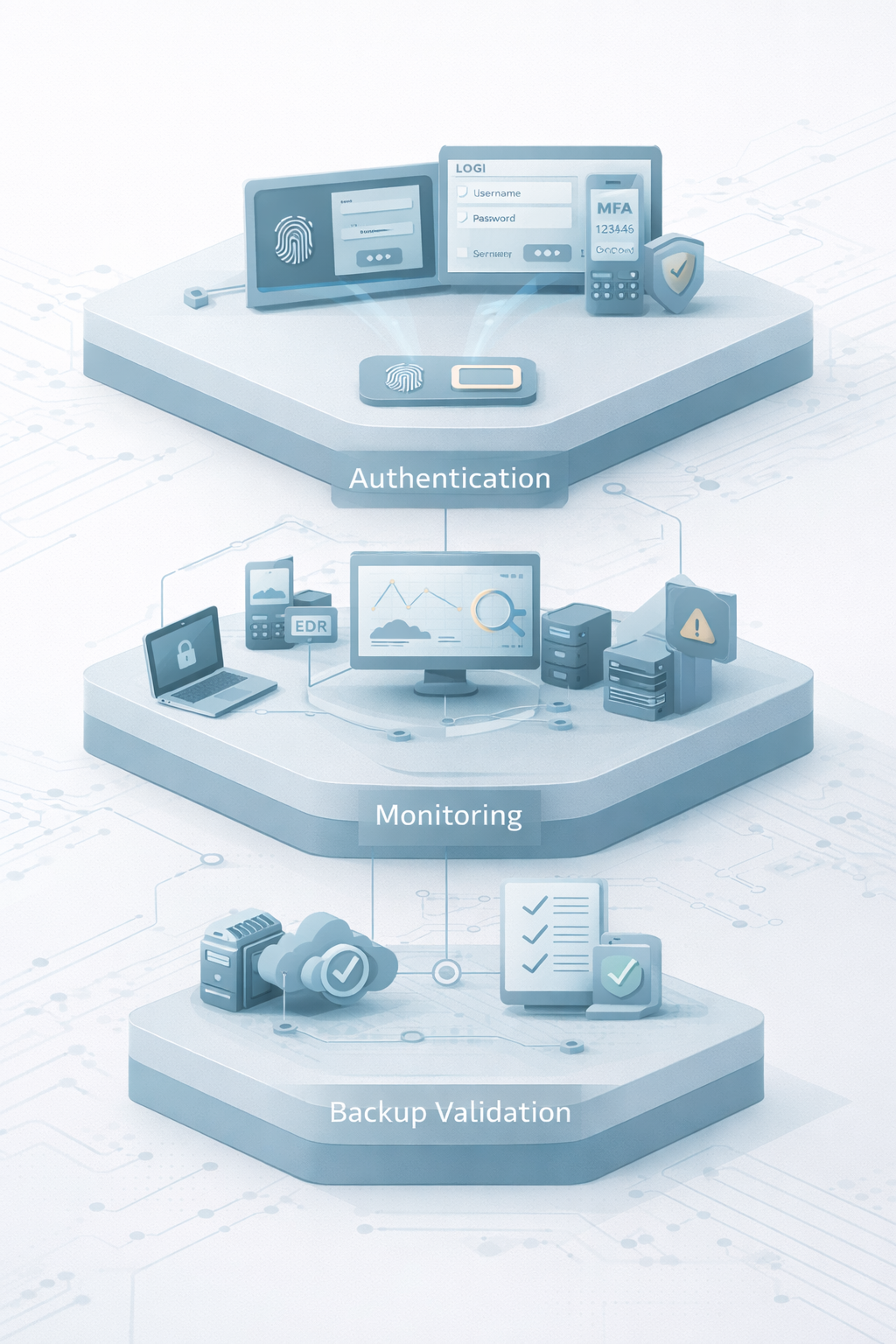
Multi-Factor Authentication (MFA)
Insurers now expect MFA coverage across multiple identity surfaces[5],including:
- Remote access (VPN)
- Email and cloud services
- Administrative accounts
- Remote management tools
Many organizations mistakenly answer “Yes” if MFA exists somewhere in the environment.
However, insurers typically expect universal enforcement across critical systems.
Partial MFA implementation is one of the most common causes of claim disputes.
Endpoint Detection and Response (EDR)
Traditional antivirus is no longer sufficient.
Modern underwriting questionnaires increasingly ask whether organizations deploy EDR or XDR platforms capable of behavioral threat detection.
EDR systems monitor:
- Endpoint activity
- privilege escalation
- ransomware behavior patterns
- suspicious command execution
Insurers view EDR as a baseline control for ransomware prevention.
Organizations still relying on legacy antivirus may find their risk profile downgraded during renewal.
Backup Architecture and Recovery Testing
Backup presence alone is not enough.
Underwriters increasingly ask whether organizations perform:
- Immutable or offline backups
- Routine restoration testing
- Segmentation from production networks
This shift reflects the reality that ransomware actors frequently target backup systems first.
The National Institute of Standards and Technology emphasizes the importance of tested recovery capabilities within its cybersecurity guidance frameworks.[6]
Unverified backups create a false sense of resilience.
Incident Response Planning
Cyber insurance carriers increasingly ask whether organizations maintain a documented and tested incident response plan.
Key expectations include:
- defined escalation paths
- legal and regulatory reporting procedures
- coordination with law enforcement
- ransomware negotiation protocols
Without documented response procedures, organizations often lose critical hours during a breach.
For insurers, this increases both financial exposure and reputational risk.
Operational Fixes: Governance Before Insurance
The fundamental mistake organizations make is assuming cyber insurance is a technical product.
It is not.
Cyber insurance is a financial instrument built on technical assumptions.
To answer questionnaires correctly, organizations must first establish governance visibility into their security architecture.
Practical improvements include:
Security Control Verification
Before completing questionnaires, organizations should validate:
- MFA coverage across identity systems
- endpoint monitoring capability
- backup integrity testing
- privileged access management
Verification eliminates the risk of incorrect assumptions.
Cross-Department Questionnaire Reviews
Cyber insurance forms should not be completed by:
- finance departments
- administrative staff
- procurement offices
Instead, responses should involve:
- IT leadership
- security personnel
- executive risk oversight
Cyber insurance questionnaires represent organizational risk declarations, not administrative forms.
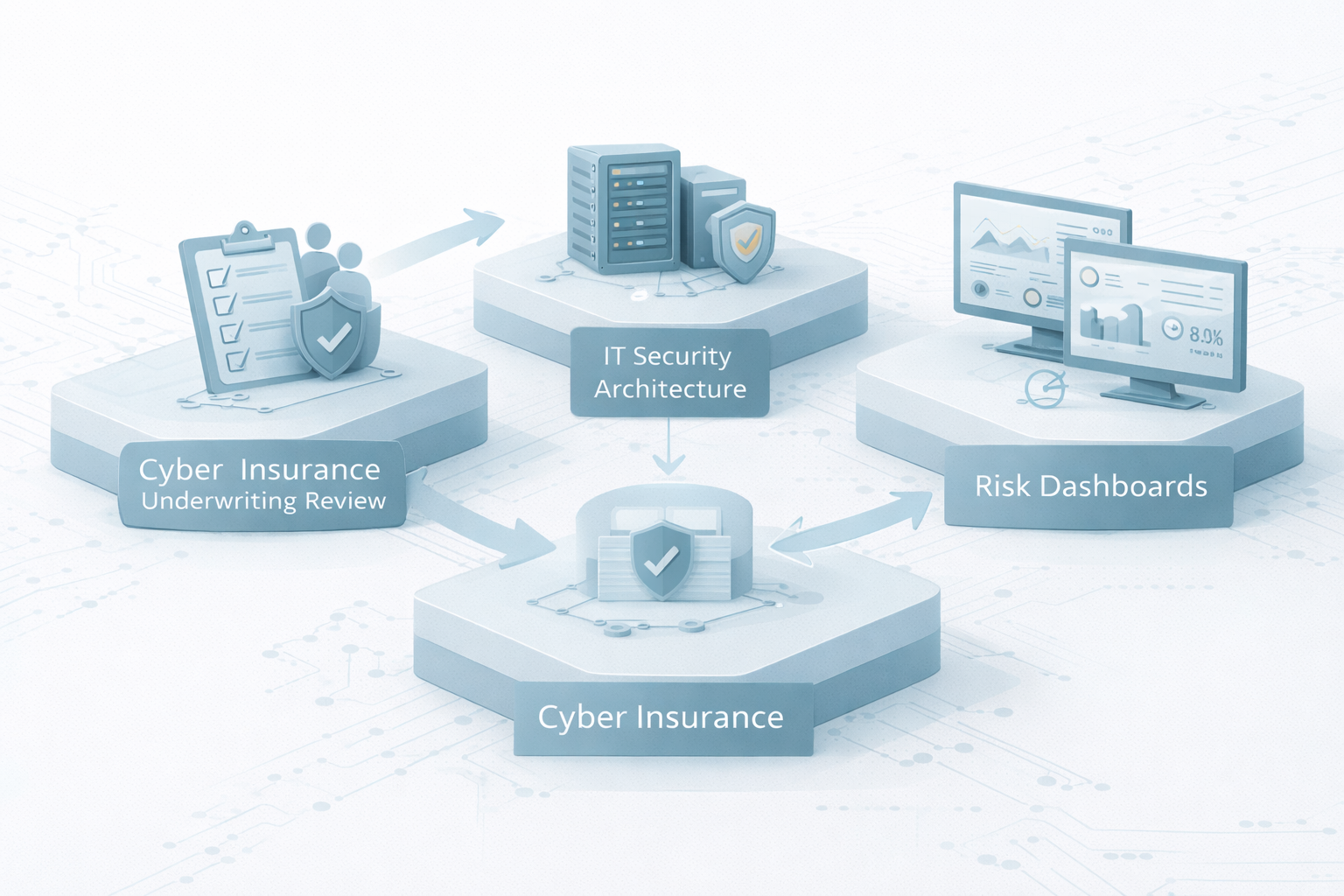
Policy-to-Architecture Mapping
Organizations should maintain documentation mapping insurance questions to:
- technical systems
- governance policies
- operational procedures
This ensures answers are traceable to real infrastructure controls.[7]
Why This Matters for Organizations Under 100,000 Population
Municipalities and smaller organizations face a unique challenge.
They often operate with:
- small IT teams
- legacy infrastructure
- limited cybersecurity budgets
At the same time, they increasingly face the same cyber threats as large enterprises.
According to guidance from Center for Internet Security, smaller governments remain high-value targets because attackers assume weaker defenses and slower recovery capabilities.[8]
Cyber insurance was originally intended to help mitigate this risk.
However, as underwriting standards increase, coverage increasingly depends on demonstrating operational cybersecurity maturity.
For municipalities and organizations under 100,000 population, this creates a paradox:
They need cyber insurance more than ever — yet qualifying for coverage now requires security governance many smaller organizations have not yet implemented.
This is where structured cybersecurity governance becomes essential.
Organizations must treat cyber insurance questionnaires as diagnostic tools revealing security gaps, not just renewal paperwork.
Immediate Action Steps
Organizations preparing for cyber insurance renewal should consider the following actions:
- Conduct a cybersecurity governance review before completing questionnaires.
- Validate MFA coverage across all remote access and privileged accounts.
- Confirm endpoint monitoring capabilities beyond traditional antivirus.
- Test backup recovery procedures at least annually.
- Document incident response processes with defined responsibilities.
These steps reduce the risk of insurance claim disputes while improving operational resilience.
FAQ
Conclusion
Cyber insurance questionnaires now represent one of the most overlooked governance checkpoints in modern cybersecurity.
They expose whether organizations truly understand:
- their security architecture
- their operational controls
- their incident response readiness
For organizations under 100,000 population, this moment is critical.
Cyber threats continue to increase, and insurers now expect evidence of operational security maturity.
Treating insurance questionnaires as administrative paperwork is no longer sustainable.
Organizations that approach them instead as governance assessments will not only secure better coverage — they will strengthen their ability to withstand cyber incidents in the first place.
Cyber insurance only works when your security controls match the policy assumptions.
Imperial Valley Info-Tech helps municipalities and organizations align governance, infrastructure, and cyber insurance readiness.
Sources
- National Association of Insurance Commissioners (NAIC).
Cybersecurity Insurance Market Report. - SecNap.
The 2025 Guide to Cyber Insurance: Navigating the New Reality of Cyber Risk. - TechTarget.
How to Find Ransomware Cyber Insurance Coverage. - SeedPod Cyber.
Cyber Insurance Requirements: Minimum Controls Checklist. - CinchIT.
Cyber Insurance Requirements Businesses Should Know. - National Institute of Standards and Technology (NIST).
Guide for Cybersecurity Event Recovery (SP 800-184). - PIA South.
Understanding Compliance Standards in the Insurance Industry. - Center for Internet Security (CIS).
Cybersecurity Resource Guide for State, Local, Tribal, and Territorial Governments.