

Your Continuity Plan Still Fails If The Decision Maker Isn’t Available
Organizations spend years building continuity plans.
Far fewer build continuity leadership.
IT Trends Weekly, Issue #41, June 14th 2026
Continuity leadership is often treated as an abstract management concept—important in theory, but secondary to technology investments, continuity plans, and emergency procedures. In practice, however, it becomes one of the most visible indicators of organizational maturity. When disruption occurs, the difference between resilience and uncertainty is frequently determined not by systems, budgets, or infrastructure, but by whether the organization knows who can make decisions when normal leadership structures are interrupted.
The call comes in.
The situation is serious.
Teams assemble.
Status reports begin.
Everyone waits for direction.
Then someone asks:
Where is the decision maker?
Who can approve emergency spending?
Who can change priorities?
Who can authorize public communications?
Who can accept risk?
Who takes over if leadership is unavailable?
The room becomes uncertain.
The challenge is not capability.
The challenge is continuity leadership.
Most organizations spend years preparing for technology failures, facility disruptions, severe weather events, and operational emergencies. They develop continuity plans, maintain disaster recovery procedures, conduct tabletop exercises, and invest in systems designed to withstand disruption. Yet many of those same organizations quietly assume that leadership will always be available. They assume authority will remain obvious, decision rights will remain intact, and the people who normally approve actions will always be reachable when circumstances demand urgent choices.
Those assumptions are increasingly fragile.
Leadership continuity is operational continuity. Authority must survive disruption. Organizations prepare extensively for system failures, but they rarely prepare for leadership gaps with the same rigor. Delegated authority is not simply an administrative convenience; it is a resilience strategy. Continuity plans fail when authority disappears, and operational resilience increasingly depends on leadership resilience. Governance becomes most visible when leadership changes unexpectedly, because organizations cannot delegate accountability—they can only delegate responsibility.
Public-sector continuity frameworks have emphasized this reality for decades. Orders of succession and delegated authority are treated not as bureaucratic exercises, but as operational safeguards designed to ensure essential functions continue regardless of who is available to lead.[1] The lesson is straightforward: resilient organizations are not distinguished by the thickness of their continuity binders. They are distinguished by the clarity of their authority structures.
Every week, IT Trends Weekly explores the governance, leadership, and operational challenges shaping resilient organizations.
Continuity Leadership Is More Than Succession Planning
Continuity leadership is often confused with succession planning, but the two concepts address different risks. Succession planning focuses primarily on long-term leadership transitions—retirements, promotions, and talent development. Continuity leadership addresses a more immediate question: who leads when the unexpected occurs? It asks whether authority can continue operating under stress, whether decisions can still be made during uncertainty, and whether the organization has prepared for temporary or sudden leadership gaps.
This distinction matters because disruption rarely announces itself on a convenient schedule. Leaders travel. Emergencies arise. Illnesses occur. Communications fail. The most resilient organizations do not assume leadership availability; they design governance structures that preserve decision-making even when key individuals are absent. Continuity leadership is therefore less about replacing executives and more about preserving authority.
For municipalities, public agencies, and operationally dependent SMBs, this challenge is particularly significant. A city manager may be the only person empowered to authorize emergency expenditures. A superintendent may be the sole authority for operational exceptions. An IT director may carry years of institutional knowledge that has never been formally transferred. During normal operations, this concentration of authority can feel efficient and practical. During disruption, it becomes a potential vulnerability.
NIST CSF 2.0 elevated governance to a core function precisely because organizations require clearly defined authority, accountability, and oversight to manage risk effectively.[2] While the framework is frequently discussed in cybersecurity circles, its principles apply far more broadly. Governance is not simply about compliance or oversight. It is about ensuring that organizations can continue to make informed decisions under changing conditions.
Leadership continuity is therefore not a human resources initiative.
It is an operational capability.
And increasingly, it is one of the defining characteristics of organizational resilience.
Municipal governments and public-sector organizations face unique operational risks. Leadership transitions, limited staffing, and growing dependencies can create hidden vulnerabilities that traditional continuity plans may not address.
IVIT helps organizations evaluate governance maturity, operational dependencies, and resilience strategies designed for long-term sustainability.
Why Organizations Depend Too Heavily On Individuals
Most organizations do not intentionally create dependency on individual leaders. The dependency develops slowly, often as a byproduct of success. Experienced executives become trusted advisors. Department heads accumulate institutional knowledge. Finance leaders become the only people comfortable approving unusual expenditures. Technical leaders become indispensable because they have solved difficult problems for years.
Over time, responsibilities become concentrated.
Then authority becomes concentrated.
Eventually, decision-making becomes concentrated.
During periods of stability, this arrangement often works exceptionally well. Decisions are made quickly. Accountability is clear. Institutional knowledge remains centralized. Few people question the arrangement because the organization continues to function efficiently.
The weakness appears only when disruption interrupts the normal flow of authority.
If a key leader becomes unavailable, uncertainty grows. If communication channels are disrupted, escalation slows. If authority has never been delegated or documented, teams hesitate to act. The result is not usually chaos. More often, it is delay—an accumulation of small uncertainties that gradually slows the organization’s response precisely when decisiveness matters most.
FEMA continuity guidance repeatedly emphasizes orders of succession and delegated authority because organizations cannot assume leadership availability during emergencies.[3] This principle applies equally to municipalities, higher education institutions, and small businesses. A city may possess excellent emergency procedures, but can departments act independently if key officials are unreachable? A school district may maintain mature operational policies, but can administrators authorize exceptions without waiting for absent leadership? A family-owned business may have experienced managers, but can they make consequential decisions if ownership is unavailable?
The answers to these questions reveal far more about resilience than most technology investments.
Leadership dependency is rarely visible during normal operations because everyone knows who to call, who approves spending, and who makes final decisions. The weakness becomes visible only during disruption. By then, it is often too late to clarify authority structures or establish new decision pathways.
Continuity governance seeks to eliminate that uncertainty before it matters. It defines decision rights, establishes escalation pathways, formalizes delegated authority, and creates visibility into who owns operational outcomes. Organizations cannot delegate accountability. But they can—and should—delegate authority.
Because resilience depends on decisions continuing even when leaders cannot.
Authority Must Survive Disruption
The purpose of continuity planning is not simply to preserve operations. It is to preserve decision-making.
That distinction is subtle, but profoundly important.
Organizations frequently invest enormous effort into protecting systems, facilities, and processes. They ask whether applications can be restored, whether communications can continue, and whether employees can work from alternate locations. These are necessary questions, and mature organizations should continue asking them. Yet an equally important question is often left unanswered:
Who decides what happens next?
Authority must survive disruption.
If leadership continuity fails, operational continuity becomes uncertain. Systems may be restored. Teams may remain capable. Communications may continue uninterrupted. But if no one possesses the authority to approve expenditures, reprioritize resources, accept operational risk, or authorize external communications, the organization begins to slow at precisely the moment decisiveness is most valuable.
This is why continuity of government frameworks place extraordinary emphasis on orders of succession and delegated authority. The objective is not to preserve hierarchy for its own sake. The objective is to preserve action. Essential functions must continue regardless of who is physically present, available, or able to participate in decision-making.[4]
The same principle applies outside government.
Municipalities depend on continuity of leadership to maintain public confidence and essential services. Higher education institutions depend on clear authority structures to support students, faculty, and staff during uncertain conditions. Operationally dependent SMBs often face an even greater challenge because authority tends to be concentrated among a very small number of individuals. The owner approves expenditures. The operations manager makes personnel decisions. The IT leader controls technology priorities. These arrangements are efficient, but efficiency and resilience are not always the same thing.
Executive backup planning is therefore more than an administrative exercise. It is an operational control.
When authority is delegated appropriately, organizations gain flexibility. Teams know who can make decisions. Escalation pathways remain visible. Risk acceptance is understood. Leadership transitions become less disruptive because authority has been designed to outlast any one individual.
This does not diminish leadership.
It strengthens it.
The most mature leaders understand that their responsibility is not to become indispensable. Their responsibility is to build organizations that remain effective even in their absence. Authority delegation is not an admission of weakness. It is an investment in operational survivability.
CISA continuity guidance reinforces this perspective, emphasizing that organizations must maintain essential functions despite disruptions affecting personnel, facilities, or technology.[5] The implication is clear: continuity is not solely about keeping systems running.
It is about keeping decisions moving.
And organizations that preserve decision-making during disruption often discover they have built something more valuable than continuity.
They have built resilience.
Leadership Continuity Is Becoming Operational Resilience
For many years, leadership continuity was viewed primarily as an executive planning exercise. It was discussed during annual retreats, folded into succession planning documents, and revisited only when retirement or organizational change seemed imminent.
That view is changing.
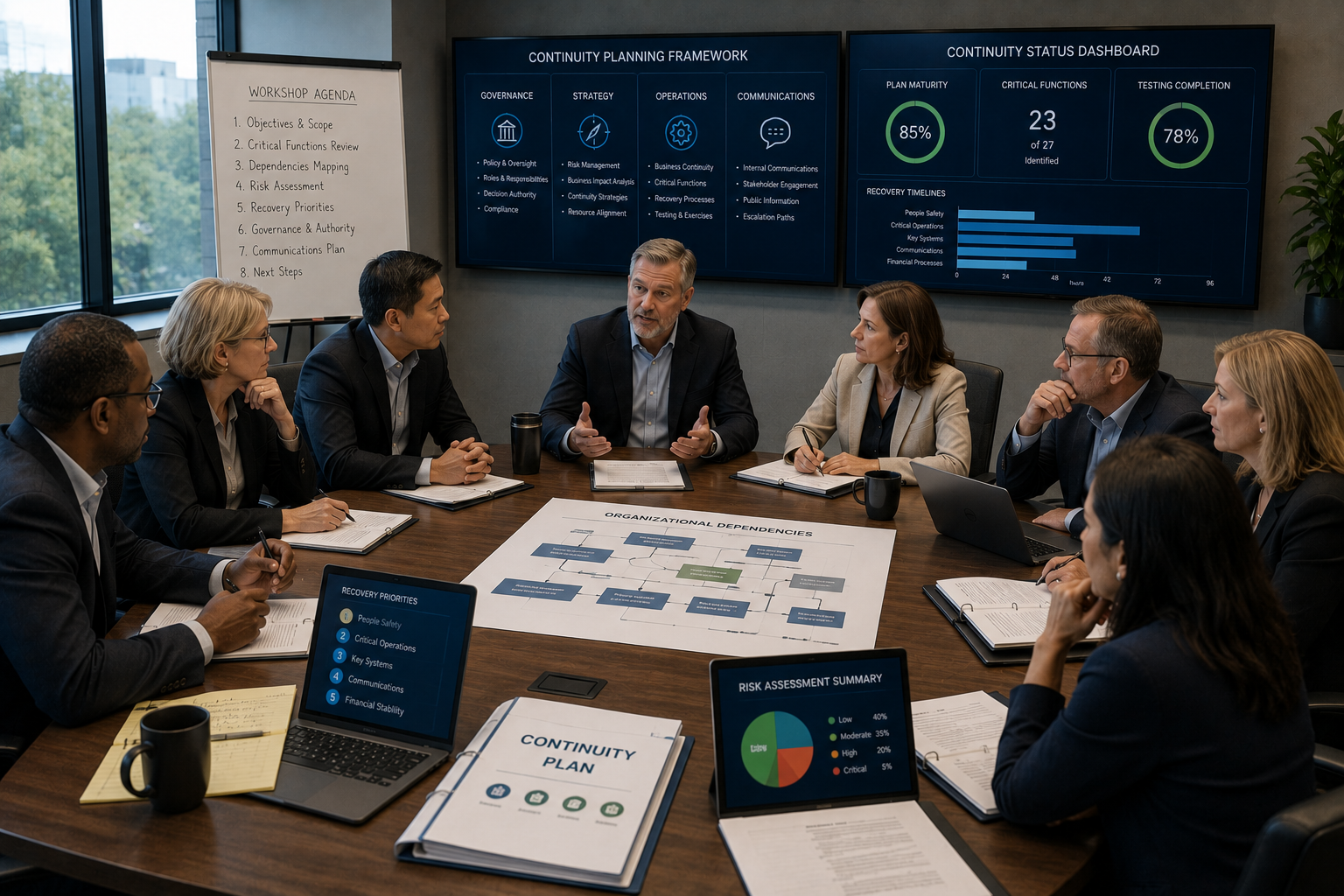
Today, leadership continuity is increasingly recognized as an operational resilience capability. Organizations are beginning to understand that resilience is not measured solely by the ability to restore systems or maintain facilities. It is measured by the ability to continue making sound decisions under changing conditions.
This shift is occurring across sectors.
Municipal governments are facing increasing operational complexity while managing limited resources and lean leadership teams. Higher education institutions must navigate evolving student needs, regulatory requirements, and operational dependencies that span multiple departments. Small and medium-sized businesses often operate with extraordinary agility, but that agility can conceal significant dependence on a handful of decision makers.
In each case, the challenge is remarkably similar.
Organizations are becoming more interconnected.
Leadership structures are becoming more complex.
And disruption is becoming less predictable.
As a result, continuity governance is evolving from a compliance activity into a resilience strategy.
The organizations adapting most effectively are not necessarily building larger leadership teams or creating more bureaucracy. They are building clarity. They understand who owns decisions. They establish delegated authority before it becomes necessary. They define escalation pathways that remain functional during disruption. And they treat leadership visibility as an operational asset rather than a personal attribute.
This perspective aligns with broader industry observations. The most resilient organizations are increasingly characterized by governance maturity, defined authority structures, and leadership practices that reduce dependence on individual actors.[6]
Leadership continuity is operational resilience because operational resilience depends on decisions.
Technology can enable recovery.
Processes can support recovery.
Facilities can sustain recovery.
But leadership determines how recovery unfolds.
Organizations that understand this distinction are often calmer during disruption. They are less dependent on improvisation. They communicate with greater confidence because decision rights are already established. Their teams act with clarity because authority structures remain visible.
Most importantly, they recognize that resilience is not built at the moment of crisis.
It is built long before disruption occurs.
Technology alone does not create resilience.
Strong governance, clear authority structures, and operational readiness help organizations make better decisions before disruption becomes disruption.
Learn how Imperial Valley Info-Tech (IVIT) approaches governance-first resilience for municipalities, SMBs, and operationally dependent organizations.
Resilient Organizations Prepare For Leadership Gaps
The most resilient organizations are not distinguished by perfect continuity plans or exhaustive procedures.
They are distinguished by their willingness to challenge assumptions.
They assume systems may fail.
They assume facilities may become unavailable.
And increasingly, they assume leadership structures may be disrupted as well.
This assumption is not pessimistic.
It is practical.
Continuity leadership recognizes that organizations are collections of people, decisions, and responsibilities operating together under changing conditions. Any one of those elements can be interrupted. Resilience comes from designing systems of governance that continue functioning regardless of which component is affected.
That is why authority delegation matters.
Why executive backup planning matters.
Why leadership succession planning is more than a human resources exercise.
And why continuity governance is becoming a defining characteristic of operational maturity.
Organizations cannot eliminate uncertainty.
They cannot predict every disruption.
They cannot guarantee leadership availability.
But they can create environments where authority remains visible, decision rights remain clear, and operational priorities continue moving forward.
That is not simply leadership resilience.
It is organizational resilience.
And increasingly, it may be one of the most important investments an organization can make.
FAQ
CONCLUSION
Continuity plans are essential.
Technology investments are essential.
Recovery strategies are essential.
But none of these capabilities can compensate for uncertainty about who is authorized to act.
The organizations that endure disruption most effectively understand this reality. They recognize that continuity depends on more than systems and procedures. It depends on leadership structures that remain functional under stress, governance frameworks that preserve authority, and cultures that value resilience over dependence on individual heroes.
Continuity leadership is therefore not a management trend or an administrative exercise.
It is an operational capability.
Authority must survive disruption because organizations cannot rely on assumptions when circumstances change unexpectedly. Governance must be visible because improvisation is rarely a substitute for preparation. And resilience must be designed intentionally because it is difficult to build in the middle of a crisis.
The future will continue to challenge organizations in new and unexpected ways.
The most resilient among them will not necessarily be those with the largest budgets, the most sophisticated technologies, or the most detailed continuity plans.
They will be the organizations that understand a simple but powerful truth:
Continuity depends on people. Resilience depends on governance. And leadership continuity is one of the most valuable operational assets an organization can possess.
Sources
[1] Federal Emergency Management Agency — Continuity Guidance Circular (CGC)
Continuity Guidance Circular
[2] National Institute of Standards and Technology — Cybersecurity Framework 2.0 (Govern Function)
NIST CSF 2.0
[3] Federal Emergency Management Agency — Continuity Resource Toolkit
FEMA Continuity Resources
[4] Cybersecurity and Infrastructure Security Agency — Continuity of Operations Resources
CISA Continuity Resources
[5] Center for Internet Security — CIS Critical Security Controls v8
CIS Controls v8
[6] Verizon — Data Breach Investigations Report
Verizon DBIR
[7] Microsoft — Digital Defense Report
Microsoft Digital Defense Report
[8] Mandiant — M-Trends Report
Mandiant M-Trends