
The AI Shadow Stack: Why Unmanaged AI Tools Are Now a Governance Risk

The AI Shadow Stack: Why Unmanaged AI Tools Are Now a Governance Risk
Executive Summary
Artificial intelligence adoption inside organizations is accelerating faster than most governance frameworks can adapt. What began as individual experimentation has evolved into widespread operational usage—often without formal approval, documentation, or lifecycle oversight.
This phenomenon—commonly called the “AI shadow stack”—refers to AI tools and services adopted outside IT governance processes. While many of these tools promise productivity gains, unmanaged adoption introduces measurable risks:
- Data leakage
- Records-retention violations
- Regulatory exposure
- Vendor risk blind spots
- Intellectual property loss
For public-sector agencies and regulated SMBs, this is no longer theoretical.
According to the 2023–2024 National Institute of Standards and Technology (NIST) Artificial Intelligence Risk Management Framework (AI RMF), AI systems introduce distinct risk categories including data governance, model bias, security vulnerabilities, and supply-chain exposure.¹
At the same time, enterprise workforce surveys show employees are adopting AI tools independently—often without informing IT or leadership.²
This week, we examine what the AI shadow stack is, why it matters now, and how boards and executive teams should respond.
What Is the AI Shadow Stack?
The AI shadow stack is an extension of traditional shadow IT.
Historically, shadow IT referred to unsanctioned SaaS tools—file-sharing platforms, project management apps, or messaging systems adopted without formal IT review.
The AI shadow stack goes further.
It includes:
- Public AI chat tools used to draft contracts or reports
- AI-powered coding assistants
- Browser-based AI extensions
- Automated content generators connected to internal data
- AI-enabled SaaS features activated without governance review
Many of these tools integrate with:
- Document repositories
- CRM systems
- Cloud storage
- Internal knowledge bases
Without formal approval workflows, organizations often have no record of:
- What data was shared
- Where prompts are stored
- Whether training data is retained
- What contractual protections exist
NIST’s AI RMF emphasizes that organizations must implement governance structures that identify, map, measure, and manage AI risks across their lifecycle.¹
Most small and mid-sized organizations are not yet doing this.
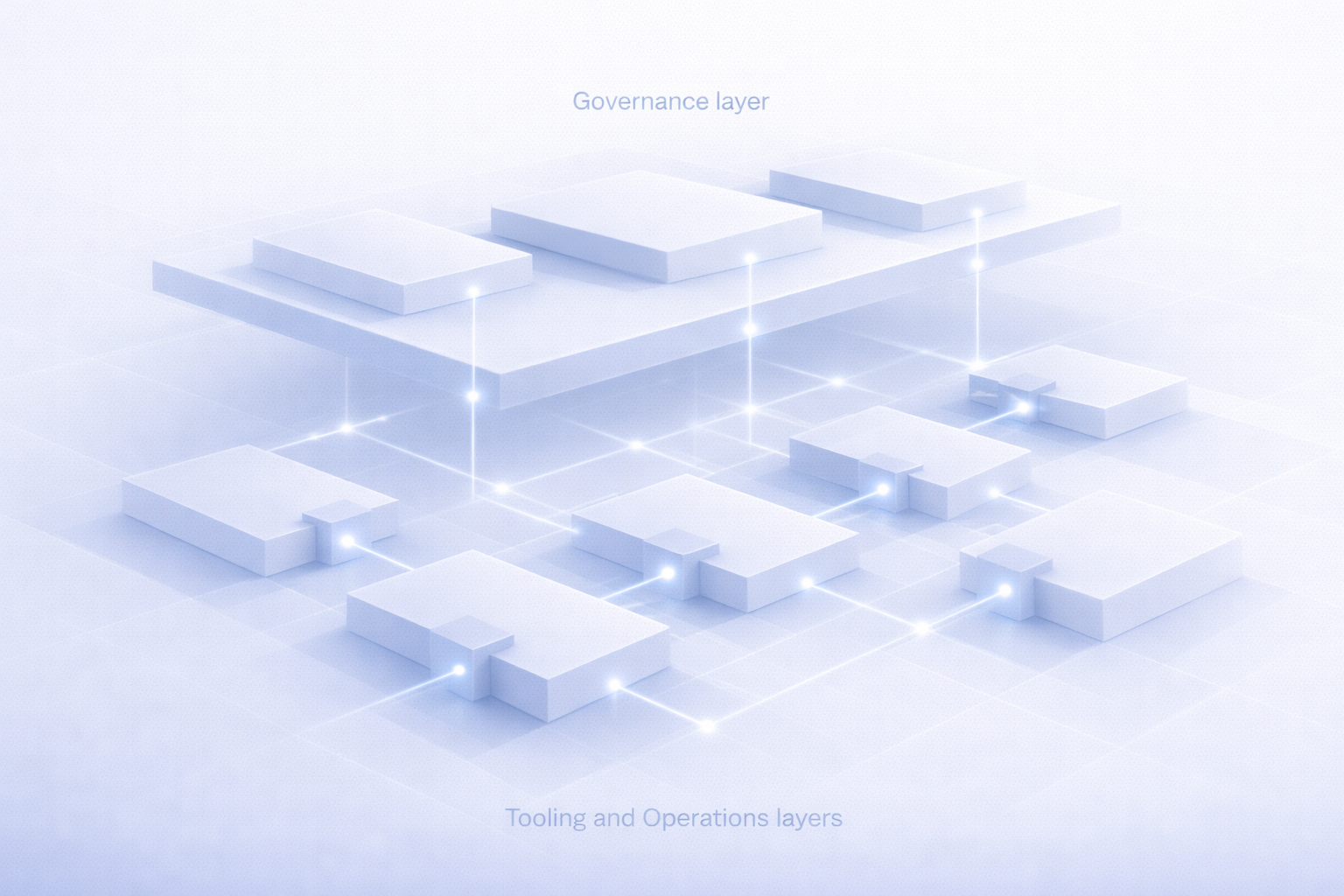
Why This Is a Governance Issue (Not a Technology Issue)
AI adoption is rarely driven by IT.
It is driven by productivity pressure.
According to the 2023 Microsoft Work Trend Index, 70% of workers report they would delegate as much work as possible to AI to reduce workload.²
The result:
Departments adopt tools independently.
IT discovers usage later—if at all.
From a governance standpoint, the risks fall into five categories:
1. Data Exposure Risk
Employees may input:
- Sensitive client information
- Law enforcement data
- Healthcare records
- Financial details
- Internal strategy documents
If AI vendors retain prompts or use data for model training, this may violate contractual or regulatory obligations.
For regulated entities subject to CJIS, HIPAA, or financial privacy requirements, this exposure can create reportable incidents.
2. Records Retention & Public Records Risk
Public agencies must comply with records retention laws.
If AI tools generate drafts, summaries, or communications stored on third-party systems:
- Are those records archived?
- Can they be retrieved?
- Are they discoverable under public records requests?
Without governance mapping, the organization may be unable to answer.
3. Vendor Risk Management Gaps
Traditional SaaS vendors undergo:
- Security reviews
- Data processing agreements
- Insurance validation
- Contract review
AI tools adopted independently often bypass this process.
The AI RMF specifically highlights third-party and supply chain risk as a core governance consideration.¹
4. Model Output Risk
AI systems can:
- Hallucinate information
- Introduce bias
- Produce incorrect citations
- Misstate legal or regulatory requirements
If those outputs are used in decision-making, the organization assumes liability.
Governance requires validation, not blind trust.
5. Intellectual Property Risk
Organizations are increasingly concerned that proprietary content entered into AI systems may be:
- Retained
- Analyzed
- Used for model refinement
Even if vendor terms prohibit this, without centralized oversight there is no policy enforcement.
Why 2026 Is the Inflection Point
AI adoption has crossed the experimentation threshold.
It is now embedded inside mainstream SaaS platforms—often turned on by default.
Features like:
- AI-generated meeting summaries
- AI email drafting
- Automated document analysis
- Predictive CRM scoring
are appearing across collaboration suites.
Boards can no longer treat AI as an isolated innovation initiative. It is now part of the operational stack.
The question is no longer:
“Are we using AI?”
It is:
“Do we know where AI is being used?”
What Governance Should Look Like
A measured response does not mean banning AI.
It means governing it.
A governance-aligned approach should include:
1. AI Asset Inventory
Map:
- Approved AI platforms
- AI features within existing SaaS
- Browser extensions
- API integrations
If it connects to organizational data, it must be documented.
2. Acceptable Use Policy
Define:
- What data may be entered
- What data may not
- When human review is required
- Documentation standards
Policies should align with NIST AI RMF lifecycle guidance.¹
3. Vendor Review & Contracts
Ensure AI vendors provide:
- Clear data retention policies
- Model training disclosures
- Security documentation
- Indemnification clarity
No exceptions for “free” tools.

4. Role-Based Controls
Restrict AI features based on:
- Sensitivity of role
- Regulatory exposure
- Access to protected information
Not every user should have unrestricted AI integration into core systems.
5. Ongoing Oversight
AI governance is not a one-time review.
It requires:
- Logging
- Periodic audits
- Incident response integration
- Board-level reporting
Just as cybersecurity matured from ad hoc to structured oversight, AI governance must follow.A measured response does not mean banning AI.
It means governing it.
A governance-aligned approach should include:
What Boards and Executives Should Ask This Quarter
- Do we have an inventory of AI tools in use?
- Have we mapped AI data flows?
- Are AI vendors included in our risk management program?
- Do employees know what they can and cannot input?
- Who owns AI oversight at the executive level?
If leadership cannot answer these clearly, the organization likely has an unmanaged AI shadow stack.
The Strategic Perspective
AI is not inherently a risk.
Unmanaged AI is.
Organizations that govern AI early will gain productivity advantages without absorbing avoidable compliance exposure.
Those that delay governance will eventually govern through incident.
The difference is strategic maturity.
Closing Thought
Shadow IT used to be a nuisance.
The AI shadow stack is a governance inflection point.
It touches:
- Data protection
- Regulatory compliance
- Vendor management
- Intellectual property
- Public trust
This is not a technology problem.
It is a board-level oversight issue.
Sources
- National Institute of Standards and Technology. Artificial Intelligence Risk Management Framework (AI RMF 1.0). 2023.
- Microsoft. 2023 Work Trend Index Annual Report.